Showing posts with label Ovenbird. Show all posts

Wednesday, May 9, 2018

April 24, 29 and May 1, 7, and 8, 2018

To say we have been busy is an understatement.  We have had 5 sessions since our last report.  Migration is such a great time to be birding and banding.  Winds and rain are a key to having many of the migrants stop for refueling, otherwise they pass right over.  There are always a few who just run out of fuel and they too will feed in places like Possum Long.  We got a few times when conditions were good so we set up when that happened as well as our scheduled Tuesdays. 

We banded a total of 77 birds in these last 5 sessions.  Only one was quite notable but more on that later.  The other 76 were typical and expected Caribbean migrants.  It's always a pleasure to see these migrants and to learn what we can about them.

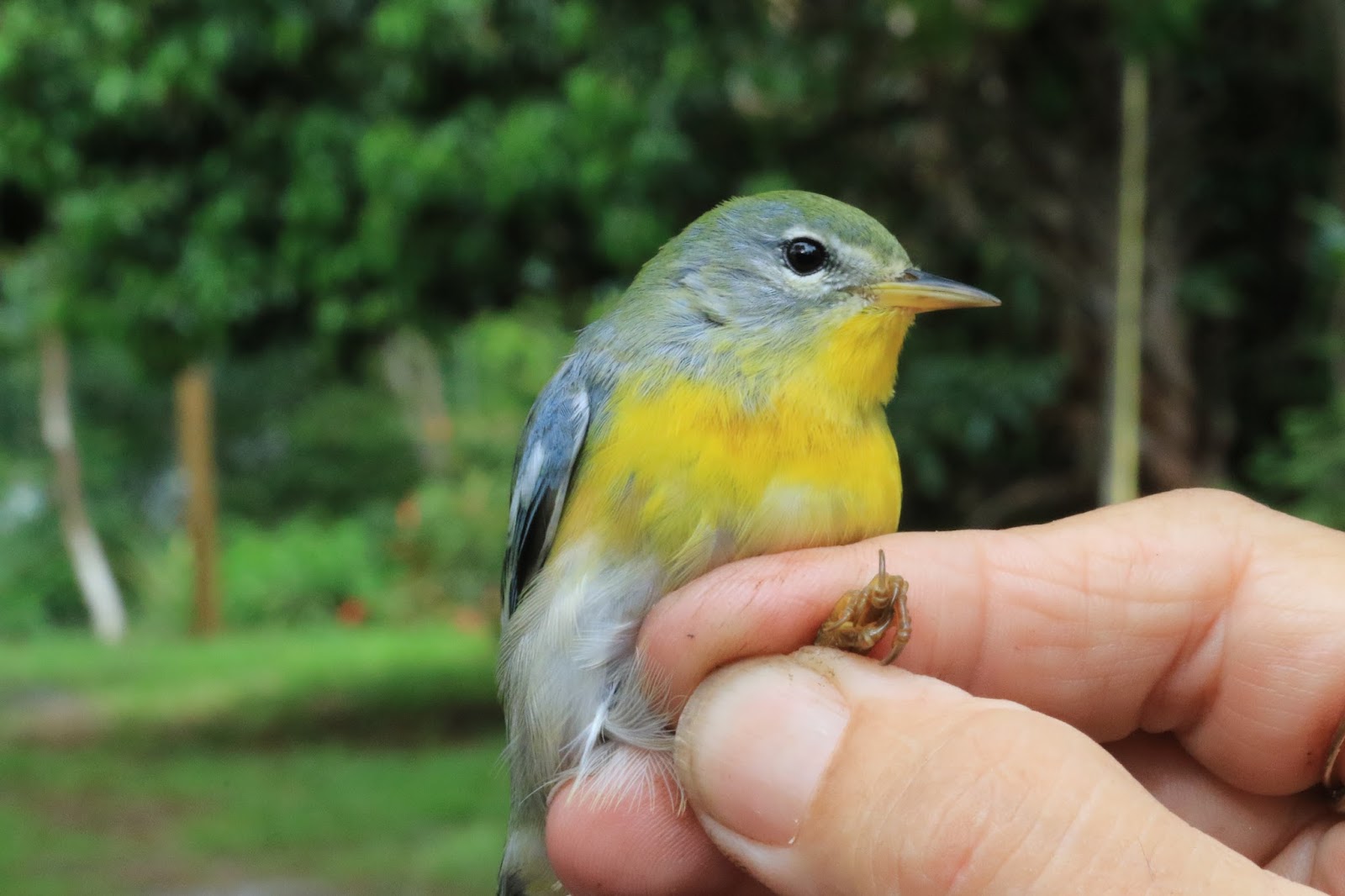
The warblers we banded were 1 Northern Parula, 12 American Redstarts, 24 Black-throated Blue Warblers, 10 Common Yellowthroats, 6 Black-and-white Warblers, 14 Ovenbirds, and 4 Northern Waterthrushes, (and 1 more).    We also banded 3 Gray Catbirds and 2 Northern Cardinals.

Black-and-white Warbler
Photo by Bill LaFramboise

Common Yellowthroat
Photo by Bill LaFramboise

Northern Waterthrush
Photo by Bill LaFramboise

Black-throated Blue Warbler
Photo by Bill LaFramboise

Ovenbird
Photo by Bill LaFramboise

The bird of note was a Connecticut Warbler.  Seeing this bird in the wild is very challenging.  They are very secretive as they pass through.  Typically winds from the west are required to drop these birds in our area.  West winds were not very strong or long but we decided to band on a Monday, May 7, because of them.  Exactly one year ago from then was the first time we ever banded this species.  Many people never see this bird.  It was never noted on the property without it being caught for banding.

Connecticut Warbler
Photo by Bill LaFramboise

We may be banding on Tuesday May 15 or any day that weather may drop birds.  Nets would go up at 6:30.  If there are no other sessions, we will do a total update on numbers once the data are compiled. 

Friday, April 20, 2018

April 16 and 17, 2018

With weather looking to change on Sunday, we decided to band on Monday as well as our usual Tuesday.  On April 16 it wasn't as birdy as we expected.  We banded 2 Black-throated Blue Warblers, 1 Ovenbird, and 1 Red-bellied Woodpecker.

Ovenbird
Photo by Bill LaFramboise

Red-bellied Woodpecker
Photo by Bill LaFramboise

We did see a few migrants including a pair of Rose-breasted Grosbeaks.  Unfortunately the property lost a lot of flowers during the hurricane so fruit is in short supply.  Birds stayed very high.  It was fun to see a banded Great Crested Flycatcher that returned.  We haven't banded one this spring so we know it has returned for this breeding season.

The weather held true for Tuesday and we did get a few more birds.  Maybe more exciting was what was on the property.  Glad to see these birds that only stay a short time but frustrating to have four species that would have been new to band.  We banded a Northern Parula, an Ovenbird, a Gray Catbird, 3 Black-throated Blue Warblers, and the two highlights:  a Cape May Warbler and our third ever Wood Thrush.

Wood Thrush
Photo by Bill LaFramboise

Cape May Warbler
Photo by Bill LaFramboise

Black-throated Blue Blue warbler
Photo by Bill LaFramboise

Though warblers were still present, the migrants seemed to be represented by larger birds.  Seen were Blue and Rose-breasted Grosbeaks, Summer Tanagers, Red-eyed and Yellow-throated Vireos, and a late Yellow-bellied Sapsucker.  What will come next week?

After Monday's session we made an afternoon visit to PB 3.  The host is not far from Possum Long and we were seeing a good interchange of birds.  It is this location that first showed that Painted Buntings can feed at least 1/2 mile away from where they were banded.  We have seen this at two other locations since.  The host reported a bird with bands that did not seem to match anything we had banded.  Though we did not catch that one we banded 2 new Painted Buntings.  Our Season 5 has ended unless we catch another one at Possum Long.  We banded 355 this season which ties our high of Season 4.

Next scheduled banding at Possum Long will be on April 24.  Nets go up at 6:30.

April 10 and 11, 2018

During migration in Florida, seeing and catching birds to band depends on the weather.  It is hard to wish for bad weather as that means birds have a very hard time getting where they need to go.  However, if it is bad, we can take advantage of the situation.

Weather forecast for Monday night was rain with winds coming from the west.  This can be ideal for seeing migrants at Possum Long.  We banded on our regular Tuesday as well as Wednesday.  Though winds stayed a little too strong for ideal capturing, we did manage to band 19 birds on Tuesday.

Very early on we caught a Swainson's Warbler - only our fifth.  These are pretty secretive birds so it is always a pleasure to get one.  This was our first during spring migration, the other four were banded in September or October.

Swainson's Warbler
Photo by Pete Grannis

We also banded a lot of Worm-eating Warblers - our highest day total of this species.  Our highest year total was 5 and we tied that this day.  Although these two species are similar in appearance, in hand one can readily see the different crowns and the much larger bill of the Swainson's.  

Worm-eating Warbler
Photo by Jan Stanard

Twelve species of warblers were seen and 8 of those we banded.  The others banded were 2 Northern Parula, 1 American Redstart, 2 Black-and-white Warblers, 1 Black-throated Blue Warbler, 2 Ovenbirds, and 1 Palm Warbler.  Others seen were Black-throated Green, Cape May, Prairie and Yellow-throated.  

American Redstart
Photo by Jan Stanard

Northern Parula
Photo by Jan Stanard

Black-and-white Warbler
Photo by Pete Grannis

Pretty much it was a warbler day with the other species banded being 2 Painted Buntings and 2 Gray Catbirds.  We also recaptured 2 Blue Jays, 2 Painted Buntings, and a House Wren.  

Wednesday was less of a warbler day but we did add another species.  We banded a Northern Waterthrush.  We added 3 more Worm-eating Warblers to break the year total.  We banded a total of 11 birds - the above and 1 Painted Bunting, 1 American Redstart, 1 Northern Parula, 1 Black-throated Blue Warbler, 2 Ovenbirds, and a Blue-headed Vireo.   Thirty birds in two sessions - a really good two day total.


Northern Waterthrush
Photos by Bill LaFramboise

Blue-headed Vireo
Photo by Bill LaFramboise


Tuesday, February 13, 2018

February 13, 2018


It was great to get together to launch the spring banding season.  We welcomed visitors and enjoyed catching up.  We had predicted today would be quiet as far as captures go but we were pleasantly surprised with the birds on the property.  There were several Summer Tanagers as well as the usual winter birds.

Newspaper photographer Hobie Hiler came to see the operation of the banding station and luckily we did have a few captures.  First we recaptured a Gray Catbird that was banded last October.  It likely spent the winter on the property or somewhere nearby.


Gray Catbird
Photo by Bill LaFramboise

We then got a female Yellow-rumped Warbler.  Looking at the upper tail feathers and the white spots on the tail as well as other features we determined it to be an adult bird.  

Yellow-rumped Warbler
Photo by Bill LaFramboise

We also recaptured an Ovenbird banded last October.  Harder to say whether this one over-wintered or is passing back through.

Ovenbird
Photo by Bill LaFramboise

Lastly was our second new bird of the day.  Another Gray Catbird but this one got a new band.

The following weeks should improve and soon we will be in the midst of spring migration.  We are still banding Painted Buntings and we will keep updating here.

Next scheduled banding at Possum Long will be February 20.  Nets go up at 6:45.  


Friday, January 19, 2018

January 15 & 16, 2018

We spent a marvelous two sessions with Painted Bunting hosts on Monday and Tuesday.

Monday's host (PB 74) is new to our project and is hosting quite a few birds.  She has been feeding buntings since 2009.  We banded 14 at her site.

male Painted Bunting
Photo by Bill LaFramboise

green (female or young male) Painted Bunting
Photo by Bill LaFramboise

We also captured a Red-bellied Woodpecker.  Woodpeckers can retain several generations of feathers over the first 3 years of life which allows specific aging to the first, second, and third year and then as older than three.  This one shows young feathers retained on its wing (red arrow).

Red-bellied Woodpecker
Photo by Bill LaFramboise

On Tuesday we returned to PB 60 and there we banded 17 new Painted Buntings as well as recapturing 13 more.  The data from the recaptures is great to have.  One of the recaptures was from 2 years ago.  It was banded as a male so is now at least 4 years old.  Pete asked who had banded that one and it turned out that he had!  It was a nice reunion.

Pete Grannis with a bird he had banded 2 years ago.  

We also banded an Ovenbird, 2 Red-bellied Woodpeckers, 3 Northern Cardinals, and a Gray Catbird.  We also recaptured an Indigo Bunting we had banded there the previous year.

Ovenbird
Photo by Bill LaFramboise

Red-bellied Woodpecker
Photo by Bill LaFramboise

Northern Cardinal
Photo by Bill LaFramboise

recaptured Indigo Bunting getting a bit of revenge
Photo by Pete Grannis

For those of you who have been following Pete's slo-mo videos, here's one of his latest of the release of a green Painted Bunting.  Enjoy!

video by Pete Grannis


If all goes well and weather cooperates, we hope to be back at the Possum Long Banding Station on February 13.  In the meantime we will be at more Painted Bunting locations and will update here.


Painted Bunting Season 5 total:  111


Monday, October 23, 2017

October 21, 2017 hosting Young Audubon

Saturday the banding station hosted a Young Audubon event for Audubon of Martin County.  Eight students in 4th, 5th, and 6th grades came to learn about bird banding.  They got to see birds, banding techniques, nets, and most of the aspects of banding smaller perching birds.  We talked about what can be learned from bird banding.  We did two exercises to understand a bit of the science.

A popular exercise was "how many at your feeder"?  Hershey miniatures representing 1 bird species came and went from a "feeder".  There were never more than 4 out at any one time.  When asked how many birds, the students realized that only 4 had appeared at any one time but that no one was sure if they were all the same.  The exercise was repeated with marked "birds".  It was quickly apparent that 8 birds had been seen but never more than 4 at a time.  The chocolates were then devoured.

We also repeated an exercise where a small stick is gathered to represent a bird leg.  They are measured with a leg gauge to determine band size.  Each one was told a bird species that had a leg that size.  They also used cut straws to color mark their bird leg.  We were fortunate to recapture a color banded Painted Bunting which really illustrated this activity.  They learned that the position of the colors determined a unique combination for each bird.

leg gauge

cut straws representing color banding

We banded a total of 14 birds and recaptured a few.  We had 1 American Redstart, 1 Blue-gray Gnatcatcher, 1 Common Yellowthroat, 1 Palm Warbler, 2 Black-throated Blue Warblers, 1 Ovenbird, 2 Red-eyed Vireos, and 5 Gray Catbirds.  Some of the students were able to release birds.  They enjoyed comparing their size band from the measuring exercise to the real ones we used.

It was such a busy event that there wasn't always time for photography but here are a few photos:

Red-eyed Vireo
Photo by Bill LaFramboise

Common Yellowthroat
Photo by Bill LaFramboise

Black-throated Blue Warbler (female)
Photo by Bill LaFramboise

Excitement for the day, besides the birds banded and sharing our project with students, was the presence of a new bird for the Possum Long property.  Robin spotted an amazing treat for all present!  Totally unexpected was a Scissor-tailed Flycatcher in the top of the large ficus tree.  Typically this species feeds over fields from low trees, power lines, or fences.  The majority of its diet is large insects like dragonflies and grasshoppers.  This bird was actually observed eating the figs from the ficus tree.  I only knew of one other instance of this species in Martin county.  There are sometimes small numbers of them in open areas in western St Lucie county over winter.  This seems like an early arrival.  It is not expected to stay in the area.

Scissor-tailed Flycatcher

Next regualrly scheduled banding is on October 24.  Nets open at 7:15.  If it is raining hard the session will not be held.  

Thursday, October 19, 2017

October 15, 2017

Sunday was a gift to birders and banders.  We banded a total of 21 birds of 12 species.  We saw 11 different kinds of warblers as well as many other migrants.  Remember you can see bird lists of this site on eBird.  Explore hotspots, type in Possum Long, view recent lists or all sorts of other data.

Many of the birds we banded were warblers:  1 American Redstart, 1 Magnolia Warbler, 1 Northern Parula, 1 Common Yellowthroat, 3 Black-throated Blue Warblers, 1 Ovenbird, and our best bird of the day.

Black-throated Blue Warbler
Photo by Bill LaFramboise

Northern Parula
Photo by Bill LaFramboise

Common Yellowthroat
Photo by Bill LaFramboise

Our best bird was a real surprise as they are tree-top lovers so we rarely catch them and also because in the fall they typically migrate more offshore.  Fall Blackpoll Warblers do not look like the "chickadee look-alike of warblers"  they are more streaked and yellowish.  However their feet still have bright soles.  

Blackpoll Warbler
Photo by Bill LaFramboise

The other 12 birds banded were 2 Red-eyed Vireos, 5 Gray Catbirds, 1 Northern Cardinal, 3 Painted Buntings (YAY!) and a Blue Jay.

Red-eyed Vireo
Photo by Bill LaFramboise

Gray Catbird
Photo by Bill LaFramboise


Continue to view the next 2 days.  Update for next session is on the October 17 post.

October 14, 2017

Because of migration we banded 4 times recently.  I have decided to post each day separately as that way I can tag the species so they can be sorted or searched for at a later date.  On Saturday we dodged rain, rain, and more rain.  We pulled the nets at 10:30 but there were plenty of birds around.

We banded 1 Gray Catbird, 3 Ovenbirds, 2 Black-throated Blue Warblers and our surprise for the day were 2 Indigo Buntings.  Both were young birds (born this past summer) one male, and one female.  On the male you can see a bit of blue on the wrist.


Indigo Bunting
Photo by Bill LaFramboise

Once the rain finally stopped and we were able to reload the car, we went birding.  There were birds all over which convinced us to return the next day.

I cannot remember any other fall with so many Scarlet Tanagers, Baltimore Orioles, Red-eyed Vireos, and Magnolia Warblers.

Magnolia Warbler
Photo by Bill LaFramboise


Baltimore Oriole
Photo by Bill LaFramboise

Continue to view the next 3 days.  Update for next session is on the October 17 post.


Tuesday, October 10, 2017

October 10, 2017

Another migration banding session at the Possum Long Banding Station was completed today.  We banded 8 birds and one was a 1 new arrival.  A lot of the fun was watching the other birds high in the ficus tree.  We noted there are still Baltimore Orioles, Scarlet and Summer Tanagers, Swainson's Thrushes, and Red-eyed Vireos around.  However, alas, we did not band any of these! 

We did band 3 Black-throated Blue Warblers.  There were many more on the property.  The photo below is of a young male with traces of white on its throat/chin.  The adult male is entirely black there.

Black-throated Blue Warbler

We banded our first of the season Veery.  Glad to have thrushes on site.

Veery
Photo by Megan Ekman

In addition to 2 Ovenbirds and an American Redstart, we banded a female Painted Bunting.  I don't know how many times I have reminded people that the green ones might not be female.  However this one is and we photographed the wing to show the feathers that show this bird is an adult (at least 15 months old) and no longer has the juvenal plumage that a young male would show.  The short feathers to the right of my thumb have green edging.

Painted Bunting (female)

A few of us hung around to see if the Monarchs were returning to the property.  Hurricane Irma blew away a lot of blooms.  Nancy Price noted a female Monarch laying eggs.  We captured it and it became our first tagged Monarch for the property.  There's an event on November 11th at Possum Long and we hope to share this tagging with children attending the event.  

Tagged Monarch

Next scheduled banding session will be October 17, 2017.  Nets go up at 7:15 am.

Monday, October 2, 2017

September 30 and October 1, 2017

We did a little extra banding this weekend since it is migration time.  We banded at Possum Long on Saturday and at PB 46 on Sunday.  Saturday was productive but a bit slower than last Tuesday's session.  We banded 13 birds (8 species) and saw a few that went no where near the nets.  These were the first of season Cape May Warbler, several Scarlet Tanagers, a Northern Parula, and a Summer Tanager.

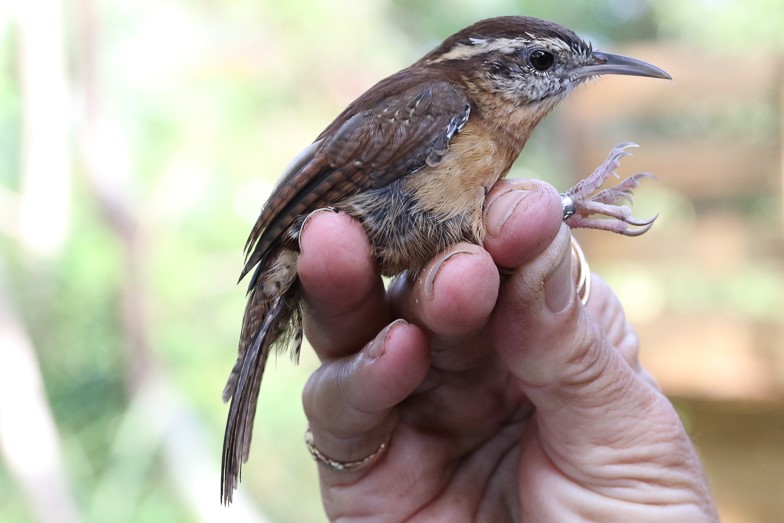
We banded 4 Black-throated Blue Warblers, 3 Ovenbirds, and one each of Red-eyed Vireo, Carolina Wren, Swainson's Thrush, Gray-cheeked Thrush, Northern Cardinal, and Gray Catbird.  Of these the thrushes made their first welcome appearance.  We should get more this month.  The Red-eyed Vireo was a young bird so it did not yet have a bright red eye.  It was the fifth one of this species for the property.  The Carolina Wren was only the second one on the property. 


Red-eyed Vireo

Carolina Wren
Photo by Bill LaFramboise

Gray-cheeked Thrush
Photo by Bill LaFramboise

Swainson's Thrush
Photo by Bill LaFramboise

At PB 46 we were pleased to catch some of their early Painted Buntings.  They estimated they had at least 10-15 birds back.  Three were previously banded.  We caught 5 new green Painteds.  we used our new split band - so be on the lookout for yellow/light green bands.

Painted Bunting with new split band color
Photo by Bill LaFramboise

One of the buntings was a very young bird.  Just out of the nest Painted Buntings, both male and female, are green and brownish.  They molt in the fall like the adults but ALL of the youngsters stay green.  They do not molt much until the next fall (about 15 months) and this is when the male birds acquire their pretty colors.  

Earlier in the season, these hosts had a 2nd year male bird starting to grow in the bright feathers.  We had received other photos just before Bob sent this one.  It is the first time we had photos of this particular change!!

Painted Bunting male acquiring its first bright feathers (approximatley 15 months old)
Photo by Bob Ellis


Back to the youngster, you can see in the photo below that it was heavily molting and that it still had some of the juvenal brownish feathers.  (Arrow)

Very young Painted Bunting with juvenal feathers
Photo by Bill LaFramboise

We also caught another Red-eyed Vireo as well as several Blue Jays, several Common Grackles, and a Northern Cardinal.  

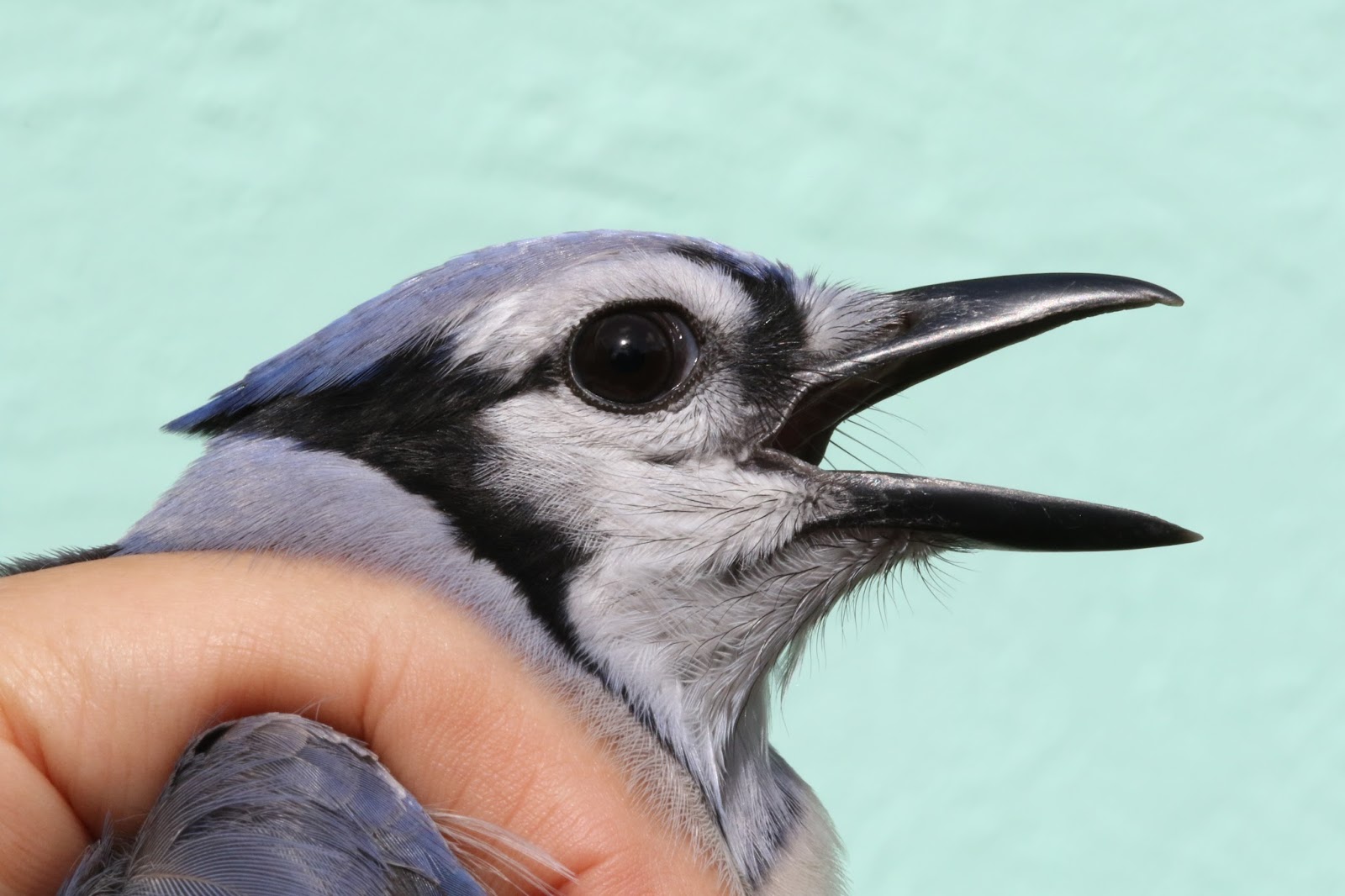
Blue Jay
Photo by Bill LaFramboise

Common Grackle
Photo by Bill LaFramboise

We will band at Possum Long tomorrow, October 3.  Nets go up at 7 am.  It could be windy so hopefully the more sheltered nets won't blow.  If they do, we will close early.