Showing posts with label Swainson's Warbler. Show all posts

Friday, April 20, 2018

April 10 and 11, 2018

During migration in Florida, seeing and catching birds to band depends on the weather.  It is hard to wish for bad weather as that means birds have a very hard time getting where they need to go.  However, if it is bad, we can take advantage of the situation.

Weather forecast for Monday night was rain with winds coming from the west.  This can be ideal for seeing migrants at Possum Long.  We banded on our regular Tuesday as well as Wednesday.  Though winds stayed a little too strong for ideal capturing, we did manage to band 19 birds on Tuesday.

Very early on we caught a Swainson's Warbler - only our fifth.  These are pretty secretive birds so it is always a pleasure to get one.  This was our first during spring migration, the other four were banded in September or October.

Swainson's Warbler
Photo by Pete Grannis

We also banded a lot of Worm-eating Warblers - our highest day total of this species.  Our highest year total was 5 and we tied that this day.  Although these two species are similar in appearance, in hand one can readily see the different crowns and the much larger bill of the Swainson's.  

Worm-eating Warbler
Photo by Jan Stanard

Twelve species of warblers were seen and 8 of those we banded.  The others banded were 2 Northern Parula, 1 American Redstart, 2 Black-and-white Warblers, 1 Black-throated Blue Warbler, 2 Ovenbirds, and 1 Palm Warbler.  Others seen were Black-throated Green, Cape May, Prairie and Yellow-throated.  

American Redstart
Photo by Jan Stanard

Northern Parula
Photo by Jan Stanard

Black-and-white Warbler
Photo by Pete Grannis

Pretty much it was a warbler day with the other species banded being 2 Painted Buntings and 2 Gray Catbirds.  We also recaptured 2 Blue Jays, 2 Painted Buntings, and a House Wren.  

Wednesday was less of a warbler day but we did add another species.  We banded a Northern Waterthrush.  We added 3 more Worm-eating Warblers to break the year total.  We banded a total of 11 birds - the above and 1 Painted Bunting, 1 American Redstart, 1 Northern Parula, 1 Black-throated Blue Warbler, 2 Ovenbirds, and a Blue-headed Vireo.   Thirty birds in two sessions - a really good two day total.


Northern Waterthrush
Photos by Bill LaFramboise

Blue-headed Vireo
Photo by Bill LaFramboise


Tuesday, September 26, 2017

September 26, 2017 Opening day was hot!

Yes, opening day was hot both in terms of weather and birds.  Thankfully the thunderstorm skirted our area.  We banded a total of 20 birds (11 species).  Some ever faithful volunteers as well as some new ones were there and kept very busy.  My thanks to all of you.

We started off with a bang as our first bird was a Swainson's Warbler our fifth ever.  We really didn't expect to catch a second one later in the day!

Swainson's Warbler

After that we had a few more typical species a Northern Cardinal and our first of the season Gray Catbird. Many birds including the catbird had fat which means they still have reserves to go farther.

 Northern Cardinal

Gray Catbird

After these birds more kept coming.  We banded 1 male Painted Bunting (first one of Season 5!), 2 American Redstarts, 1 Black-throated Blue Warbler, 3 Black-and-white Warblers, a Common Yellowthroat, a White-eyed Vireo, 6 Ovenbirds, and what I consider the bird of the day.  I do think others may disagree but it was pretty good in my opinion.

Common Yellowthroat

Ovenbird

Black-and-white Warbler

Painted Bunting

Black-throated Blue Warbler

American Redstart

There were a few other migrants present on the property today including Red-eyed Vireos, a Scarlet Tanager, and Northern Parulas.  

So what I consider the bird of the day I had only banded one other of this species before and have seen under 10 of these in Florida!  We had a Chestnut-sided Warbler today.  The unique yellow-green color and chestnut sides were exciting to see up close.

Chestnut-sided Warbler

Chestnut-sided Warbler


Chestnut-sided Warbler
Photo by Robin Potvin

Quite the opening day.  Things should continue to be busy (we hope) for the next few weeks.  The next session will be on October 3.  Nets go up around 7 am.  


Saturday, October 1, 2016

October 1, 2016 Migration bliss

Due to approaching weather (Hurricane Matthew), multitudes of great migrant reports, and many good birds at Possum Long yesterday, I decided to run a session today.  Well worth it!  We saw 27 species (many migrants including a bunch of Cape May Warblers) and banded 14 birds (8 species) and recaptured 2 more.

Once again we banded Swainson's Thrush - three of them.  There were more unbanded ones viewed.

Swainson's Thrush

We also banded three more Ovenbirds.

Ovenbird

One of the species banded early in the morning was a Northern Parula.  This is a young bird with the typical red and/or slate breast band are not developed.  The wing bars and yellow lower bill are visible.  

Northern Parula
Photo by Robin Potvin

A very big surprise was a Swainson's Warbler.  The previous ones (only 3!) we banded were in September.  Upon returning home I read that there was one banded in Georgia today so maybe more will be coming through.  

Swainson's Warbler
Photo by Robin Potvin

The Worm-eating Warbler we banded was a good species to compare with the Swainson's Warbler. The central crown stripe and bill size look quite different.

Worm-eating Warbler

Today was a "three species of thrushes" day.  In addition to the Swainson's Thrush above, we banded a Veery and a Gray-cheeked Thrush.  The Gray-cheeked measured beyond a doubt to be well out of the range of Bicknell's Thrush.  The Veery, below, shows the classic red/rufous color of this species.  

Gray-cheeked Thrush

Veery

The last species banded was Black-throated Blue Warbler.  Banding three of them made for nice age and subspecies comparisons.  Two of the birds were adult males, the other was a young bird.  Two were the Appalachian subspecies (black marking on the back) and one was from the non-Appalachian population.

Black-throated Blue Warbler

Black-throated Blue Warbler
Appalachian subspecies
Photos by Robin Potvin

Our recaptures were exciting.  Both had been banded in September, 2013 as hatch-year birds.  So both are three years old.

White-eyed Vireo

Blue Jay

Next banding:  Tuesday, October 4, but Hurricane Matthew may cancel this session.  Email keepbirding2@yahoo.com if you want to be notified of session status.  If clear, nets go up at 6:45 am.  


Tuesday, September 23, 2014

September 22 & 23, 2014

Well, I didn't believe that history would repeat itself but it did - twice.  We did an impromptu banding yesterday and banded one bird - another Swainson's Warbler!!  There were quite a few migrants around so we had high hopes for today's regular session.

Swainson's Warbler
Photo by Nancy LaFramboise

Today we caught the third Swainson's Warbler this fall; you'd think they were a common bird. Actually the timing is right and the weather has caused a lot of birds to stop here instead of flying right through.  We have been fortunate that we have dodged the rain these past few weeks.  There has certainly been a lot of it.

 Swainson's Warblers
Photo by Jane Wiewora

photo by Nancy LaFramboise

We also captured two Worm-eating Warblers today.  Though they are superficially similar, this composite shows the striping differences of these two warblers. 

Top- Swainson's Warbler
Bottom - Worm-eating Warbler
Photo by Jane Wiewora

There were quite a few migrants on the property the past two days including Common Yellowthroats, Summer Tanagers, Black-throated Blue Warblers, Red-eyed Vireos, Eastern Wood-Pewee, American Redstarts, Ruby-throated Hummingbirds, and a Merlin.

We caught the first thrush of the season and hope for at least a few more.  Today's thrush was a Veery.  It is identified by its overall reddish color on the back and the wash through the spots.  This species was also banded almost exactly 1 year ago!

Veery


Photos by Nancy Price

And last but not least (well maybe in size), we had a Northern Parula today.  This small warbler weighed in at 6 grams!  This lovely close-up shows the tiny amount of red on this bird's chest and also shows the light underside of the bill.  Adult males have a full black and rusty red breast band.  

Northern Parula
Photo by Jane Wiewora

Next regular session will be on September 30.  Nets go up at 6:45.  Hope to see you then.

Tuesday, September 9, 2014

September 9, 2014 A day of stripes!

The migrants have arrived and they did so in style!  Today was the day of the stripes.  Our first bird in the nets was a Northern Waterthrush, a first for Possum Long, my second ever.  The previous one was at a Painted Bunting location last winter.

Northern Waterthrush
Photo by Nancy LaFramboise
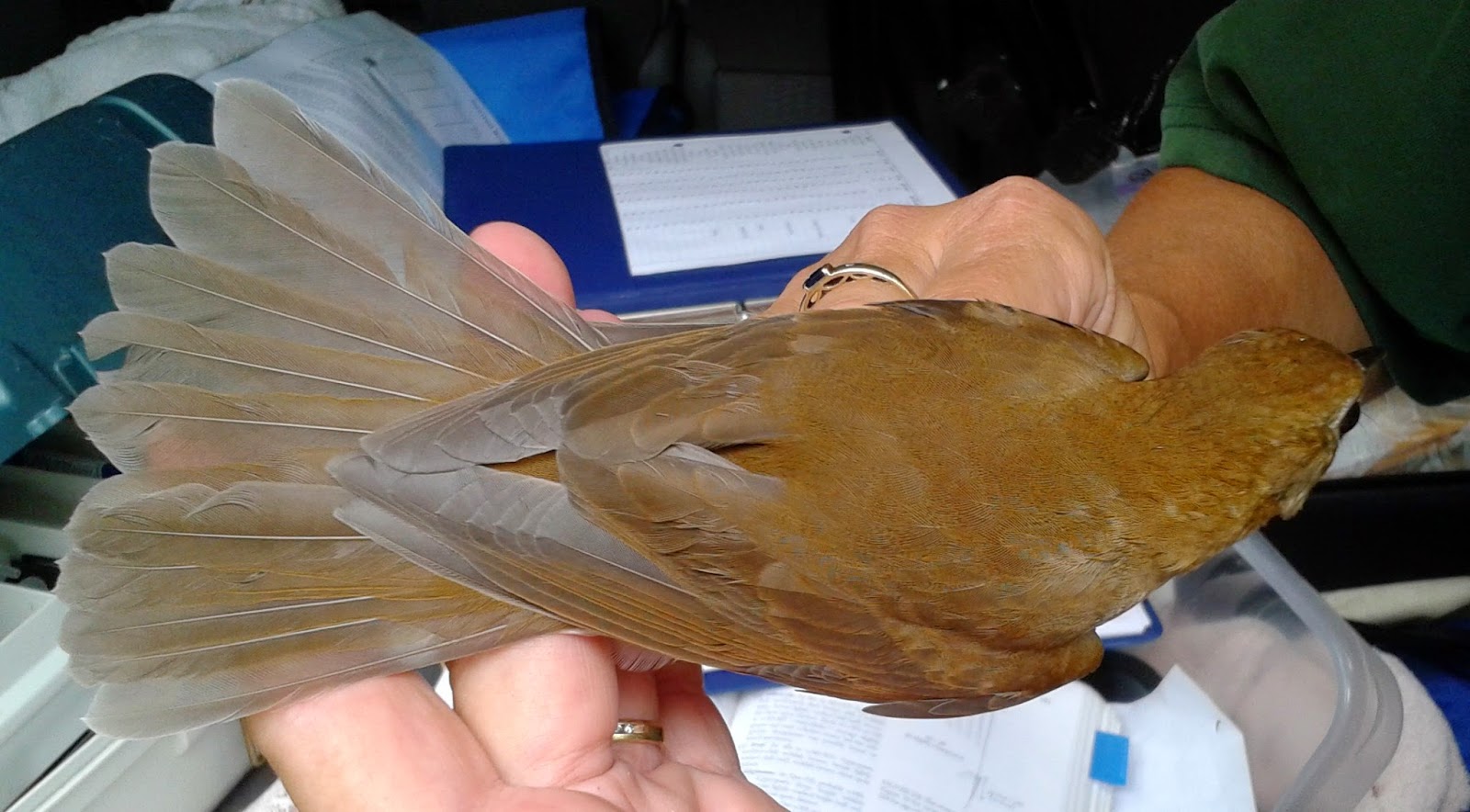
Our second bird was a record breaker!!  This bird had never been documented in Martin County that we know of.  It is a migrant bird that lurks in thick undergrowth and has probably been through the area before but no one had detected or documented it. It was also a new species for me to band.  

Swainson's Warbler
Photo by Nancy Price

You can see the difference from the above Northern Waterthrush (no streaks) and if you look at Worm-eating Warbler below you can see the rusty cap (Swainson's) instead of the multiple stripes (Worm-eating).  The Swainson's Warbler's bill is also larger.  I love its tiny feet.  

Worm-eating Warbler (from another session)
Photo by Georgia Binderow

Swainson's Warbler
Photo by Nancy Price

The next stripes of the day were those of the Ovenbird, our first and second of the season.  See the stripes?


Ovenbirds
Both photos by Georgia Binderow

Last but not least, we caught a very young Northern Cardinal.  Its bill is still dark and its crest isn't fully developed.

Northern Cardinal
Photo by Nancy LaFramboise

One of the things that a bander can look at to age a new, young bird is evidence that all of the tail feathers grew in at the same time.  An adult molts its feathers in a symmetric sequence, not all at the same time.  When the young bird is being fed, there are different colors deposited in the tail as food type and abundance varies.  Sometimes we can see these bands of color and if they are lined up, it means the feathers grew in together.  This photo was enhanced to show the faint bands on the tail that we can see when we hold the feathers up to the light.  See if you can see bands near the upper center - hopefully the photo isn't too small.

Northern Cardinal
Photo by Nancy LaFramboise

We had a wonderful session.  Migration should bring us more delights for the next few weeks.  Hope you can join us at the station or here on the blog.

Next session, September 16.  Nets go up at 6:30 am.