Showing posts with label Common Yellowthroat. Show all posts

Wednesday, May 9, 2018

April 24, 29 and May 1, 7, and 8, 2018

To say we have been busy is an understatement.  We have had 5 sessions since our last report.  Migration is such a great time to be birding and banding.  Winds and rain are a key to having many of the migrants stop for refueling, otherwise they pass right over.  There are always a few who just run out of fuel and they too will feed in places like Possum Long.  We got a few times when conditions were good so we set up when that happened as well as our scheduled Tuesdays. 

We banded a total of 77 birds in these last 5 sessions.  Only one was quite notable but more on that later.  The other 76 were typical and expected Caribbean migrants.  It's always a pleasure to see these migrants and to learn what we can about them.

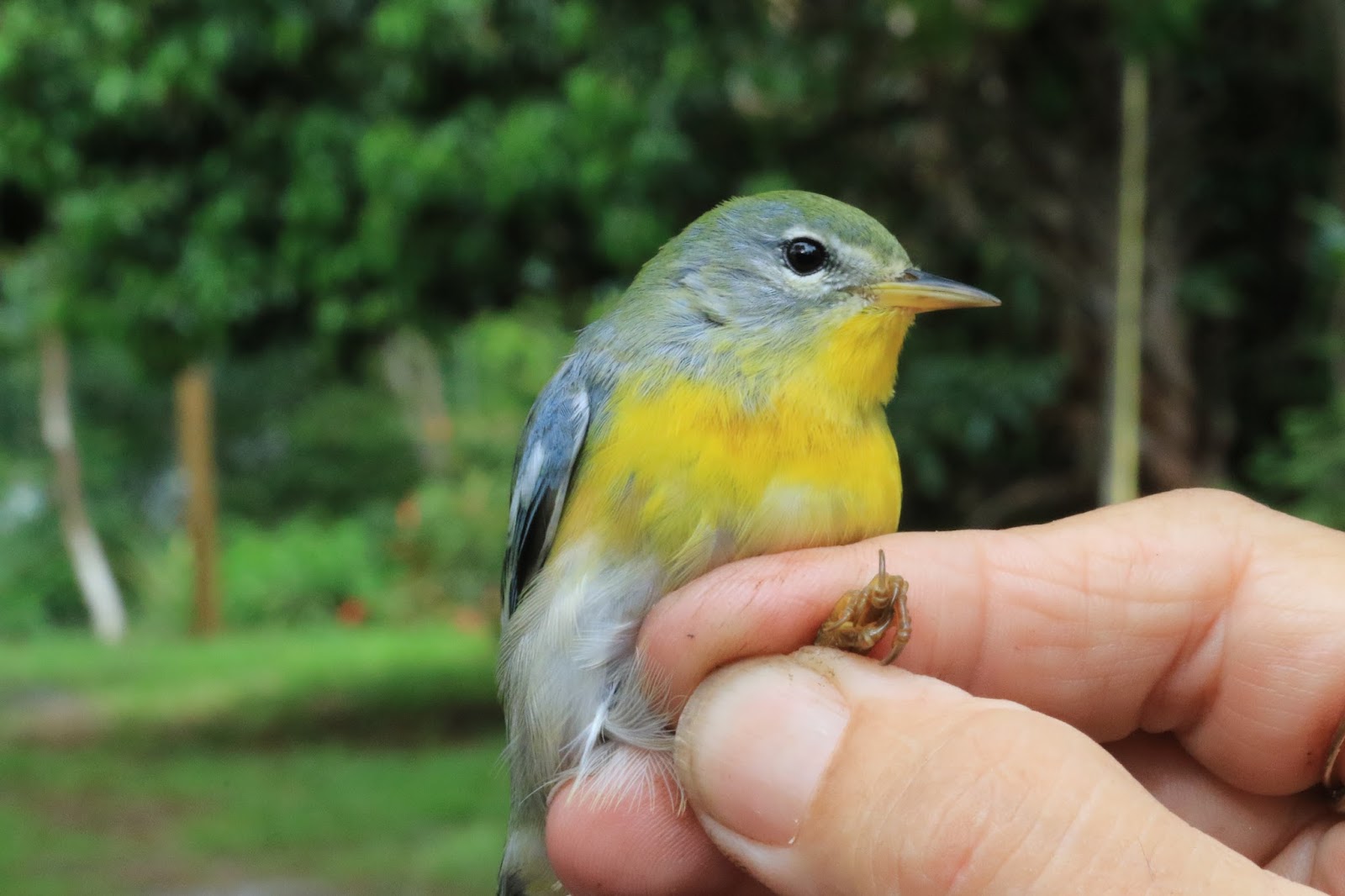
The warblers we banded were 1 Northern Parula, 12 American Redstarts, 24 Black-throated Blue Warblers, 10 Common Yellowthroats, 6 Black-and-white Warblers, 14 Ovenbirds, and 4 Northern Waterthrushes, (and 1 more).    We also banded 3 Gray Catbirds and 2 Northern Cardinals.

Black-and-white Warbler
Photo by Bill LaFramboise

Common Yellowthroat
Photo by Bill LaFramboise

Northern Waterthrush
Photo by Bill LaFramboise

Black-throated Blue Warbler
Photo by Bill LaFramboise

Ovenbird
Photo by Bill LaFramboise

The bird of note was a Connecticut Warbler.  Seeing this bird in the wild is very challenging.  They are very secretive as they pass through.  Typically winds from the west are required to drop these birds in our area.  West winds were not very strong or long but we decided to band on a Monday, May 7, because of them.  Exactly one year ago from then was the first time we ever banded this species.  Many people never see this bird.  It was never noted on the property without it being caught for banding.

Connecticut Warbler
Photo by Bill LaFramboise

We may be banding on Tuesday May 15 or any day that weather may drop birds.  Nets would go up at 6:30.  If there are no other sessions, we will do a total update on numbers once the data are compiled. 

Sunday, February 25, 2018

February 20, 2018

Tuesday, February 20 was a session at the Possum Long Banding Station.  It was a day of wonderful bird viewing.  There were more birds on and above the property but we only banded 5 birds.  This is an increase and we should continue to increase but the hard part is that nets are low and birds are high.

There were hundreds of Cedar Waxwings on the property and it felt like teasing!  So close yet so far.

Cedar Waxwings at Possum Long - just one of the trees
Photo by Robin Potvin

Cedar Waxwings at Possum Long
Photo by Robin Potvin

Also on the property was a Summer Tanager.  We have been spotting them for the last few weeks.  Not sure if they over-wintered again.  Both species were seen eating fruit from the Ficus (Fig) trees.  

Summer Tanager
Photo by Pete Grannis

However we did band 2 Northern Cardinals, 2 Gray Catbirds and a Yellow-rumped Warbler.  Among other recaptures we had a Common Yellowthroat that was banded in October.  

Yellow-rumped Warbler
Photo by Bill LaFramboise

Common Yellowthroat
Photo by Pat Marshall

Gray Catbird - I love revenge photos - bird biting bander
Photo by Bill LaFramboise

Congratulations to fellow birder Andrew Boyle and his volunteers.  They banded at the Orlando Wetlands Festival and had some great birds including a Philadelphia Vireo which was a surprise as they do not typically over-winter in Florida.  Read more a https://wekivaband.blogspot.com/    The 2/17/18 entry.

Next Possum Long session will be on Tuesday, February 27.  Nets go up at 6:45 am.

A very early warning - we will NOT be banding on March 20 but will on March 19.  (Weather permitting as always)


Monday, November 13, 2017

November 4, 5, and 7, 2017

Things have really slowed down yet we are still catching a few new birds.  We banded at PB 32 on Saturday and at Possum Long on Sunday and Tuesday.

Painted Bunting sessions will become more of our entries over the next few months.  We will continue at Possum Long until early December but will be taking a break over the holidays.

Our return trip to PB 32 was productive.  We banded 2 new buntings and recaptured another.  It is always great visiting with our hosts.

Painted Bunting
Photo by Bill LaFramboise

On Sunday we tried setting up at the pond at Possum Long.  Unfortunately the water is high so we cannot span the water as we have in the past.  We did manage to catch a Painted Bunting, 2 Gray Catbirds, a Common Yellowthroat, and an Eastern Phoebe.  Eastern Phoebes are winter residents and we rarely catch them.

Eastern Phoebe
Photo by Bill LaFramboise

Gray Catbird
Photo by Bill LaFramboise

Common Yellowthroat
Photo by Bill LaFramboise

At our regular Tuesday session we again caught Painted Buntings, two of them.  The good news is there seem to still be some banded and unbanded ones around.  Maybe they are still arriving??  We also caught a Common Yellowthroat that had been banded last year.  Nice to see some site fidelity in that species.

Painted Bunting - hatch year, sex unknown
Photo by Pete Grannis

Common Yellowthroat
Photo by Pete Grannis

The next regularly scheduled Possum Long banding will be on November 14.  Nets go up at 6:15.  


Monday, October 23, 2017

October 21, 2017 hosting Young Audubon

Saturday the banding station hosted a Young Audubon event for Audubon of Martin County.  Eight students in 4th, 5th, and 6th grades came to learn about bird banding.  They got to see birds, banding techniques, nets, and most of the aspects of banding smaller perching birds.  We talked about what can be learned from bird banding.  We did two exercises to understand a bit of the science.

A popular exercise was "how many at your feeder"?  Hershey miniatures representing 1 bird species came and went from a "feeder".  There were never more than 4 out at any one time.  When asked how many birds, the students realized that only 4 had appeared at any one time but that no one was sure if they were all the same.  The exercise was repeated with marked "birds".  It was quickly apparent that 8 birds had been seen but never more than 4 at a time.  The chocolates were then devoured.

We also repeated an exercise where a small stick is gathered to represent a bird leg.  They are measured with a leg gauge to determine band size.  Each one was told a bird species that had a leg that size.  They also used cut straws to color mark their bird leg.  We were fortunate to recapture a color banded Painted Bunting which really illustrated this activity.  They learned that the position of the colors determined a unique combination for each bird.

leg gauge

cut straws representing color banding

We banded a total of 14 birds and recaptured a few.  We had 1 American Redstart, 1 Blue-gray Gnatcatcher, 1 Common Yellowthroat, 1 Palm Warbler, 2 Black-throated Blue Warblers, 1 Ovenbird, 2 Red-eyed Vireos, and 5 Gray Catbirds.  Some of the students were able to release birds.  They enjoyed comparing their size band from the measuring exercise to the real ones we used.

It was such a busy event that there wasn't always time for photography but here are a few photos:

Red-eyed Vireo
Photo by Bill LaFramboise

Common Yellowthroat
Photo by Bill LaFramboise

Black-throated Blue Warbler (female)
Photo by Bill LaFramboise

Excitement for the day, besides the birds banded and sharing our project with students, was the presence of a new bird for the Possum Long property.  Robin spotted an amazing treat for all present!  Totally unexpected was a Scissor-tailed Flycatcher in the top of the large ficus tree.  Typically this species feeds over fields from low trees, power lines, or fences.  The majority of its diet is large insects like dragonflies and grasshoppers.  This bird was actually observed eating the figs from the ficus tree.  I only knew of one other instance of this species in Martin county.  There are sometimes small numbers of them in open areas in western St Lucie county over winter.  This seems like an early arrival.  It is not expected to stay in the area.

Scissor-tailed Flycatcher

Next regualrly scheduled banding is on October 24.  Nets open at 7:15.  If it is raining hard the session will not be held.  

Thursday, October 19, 2017

October 15, 2017

Sunday was a gift to birders and banders.  We banded a total of 21 birds of 12 species.  We saw 11 different kinds of warblers as well as many other migrants.  Remember you can see bird lists of this site on eBird.  Explore hotspots, type in Possum Long, view recent lists or all sorts of other data.

Many of the birds we banded were warblers:  1 American Redstart, 1 Magnolia Warbler, 1 Northern Parula, 1 Common Yellowthroat, 3 Black-throated Blue Warblers, 1 Ovenbird, and our best bird of the day.

Black-throated Blue Warbler
Photo by Bill LaFramboise

Northern Parula
Photo by Bill LaFramboise

Common Yellowthroat
Photo by Bill LaFramboise

Our best bird was a real surprise as they are tree-top lovers so we rarely catch them and also because in the fall they typically migrate more offshore.  Fall Blackpoll Warblers do not look like the "chickadee look-alike of warblers"  they are more streaked and yellowish.  However their feet still have bright soles.  

Blackpoll Warbler
Photo by Bill LaFramboise

The other 12 birds banded were 2 Red-eyed Vireos, 5 Gray Catbirds, 1 Northern Cardinal, 3 Painted Buntings (YAY!) and a Blue Jay.

Red-eyed Vireo
Photo by Bill LaFramboise

Gray Catbird
Photo by Bill LaFramboise


Continue to view the next 2 days.  Update for next session is on the October 17 post.

Tuesday, September 26, 2017

September 26, 2017 Opening day was hot!

Yes, opening day was hot both in terms of weather and birds.  Thankfully the thunderstorm skirted our area.  We banded a total of 20 birds (11 species).  Some ever faithful volunteers as well as some new ones were there and kept very busy.  My thanks to all of you.

We started off with a bang as our first bird was a Swainson's Warbler our fifth ever.  We really didn't expect to catch a second one later in the day!

Swainson's Warbler

After that we had a few more typical species a Northern Cardinal and our first of the season Gray Catbird. Many birds including the catbird had fat which means they still have reserves to go farther.

 Northern Cardinal

Gray Catbird

After these birds more kept coming.  We banded 1 male Painted Bunting (first one of Season 5!), 2 American Redstarts, 1 Black-throated Blue Warbler, 3 Black-and-white Warblers, a Common Yellowthroat, a White-eyed Vireo, 6 Ovenbirds, and what I consider the bird of the day.  I do think others may disagree but it was pretty good in my opinion.

Common Yellowthroat

Ovenbird

Black-and-white Warbler

Painted Bunting

Black-throated Blue Warbler

American Redstart

There were a few other migrants present on the property today including Red-eyed Vireos, a Scarlet Tanager, and Northern Parulas.  

So what I consider the bird of the day I had only banded one other of this species before and have seen under 10 of these in Florida!  We had a Chestnut-sided Warbler today.  The unique yellow-green color and chestnut sides were exciting to see up close.

Chestnut-sided Warbler

Chestnut-sided Warbler


Chestnut-sided Warbler
Photo by Robin Potvin

Quite the opening day.  Things should continue to be busy (we hope) for the next few weeks.  The next session will be on October 3.  Nets go up around 7 am.  


Wednesday, May 17, 2017

May 16, 2017

Once again winds shifted and were coming from the east.  Late migrants are practically finished and I hope they are mostly to their breeding grounds and have successful nesting.  We observed a few redstarts at Possum Long on Tuesday and we banded 2 new birds.  One Ovenbird and one Common Yellowthroat managed to find the nets.

Ovenbird

Common Yellowthroat

Thus ends the Spring 2017 banding at Possum Long.  My thanks to all readers who keep in touch.  My overwhelming appreciation to the volunteers who make this research possible.  We will resume banding some time in August.  I will post dates on an entry here.  For some reason this blog tells me I have 1 follower but I know more of you do get email reminders when I post.  If you have not signed up for that, you might consider doing so.  

I will soon post the results since the start of 2017 and some overall numbers.  I find numbers to be quite amazing and I hope you, my readers do too.


Monday, May 15, 2017

May 12 and 14, 2017 - Three of a Kind - a winning hand!

Following the success of last week, we decided to try an extra session on Friday.  There were a few remnant (hungry?) warblers around.  We saw Blackpoll Warblers and caught 2 American Redstarts and a Northern Waterthrush.  This has certainly been more redstarts and waterthrushes than ever before.

Northern Waterthrush
Photo by Bill LaFramboise

Sunday, although it was Mother's Day, we were thinking of banding.  The forecast was for a little bit of rain in the early morning and then winds from the west.  Usually one needs these winds overnight but we decided to at least listen at the property.  There seemed to be a lot of redstarts present so we set up a few nets.  First capture was another Northern Waterthrush.  Then came the redstarts.  Then another big surprise - our second ever Connecticut Warbler.  

Connecticut Warbler
Photo by Bill LaFramboise

Birds were present, we saw a Cape May Warbler.  Then we caught ANOTHER Connecticut Warbler. If you read the entry from May 7 you know how unbelievable this really was.

Connecticut Warbler
Photo by Bill LaFramboise

Not long after, the third Connecticut Warbler.  Stunningly shocked!  It was a very well marked male.

Connecticut Warbler

Connecticut Warbler
Photo by Bill LaFramboise

We ended up with two Great Crested Flycatchers who likely have finished with their nesting.

Great Crested Flycatcher

In total we banded 5 American Redstarts, 1 Northern Waterthrush, 2 Black-throated Blue Warblers, 2 Common Yellowthroats, 3 Connecticut Warblers, and 2 Great Crested Flycatchers.  An awesome day.

American Redstart
After second year male

Common Yellowthroat female

The next session at Possum Long will be on May 16.  Nets go up at 6:15.  There may be a few lingering migrants.  Bring bug spray if you are bothered but keep in mind it is not good for the nets or the birds.