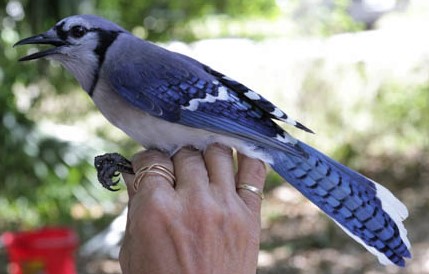
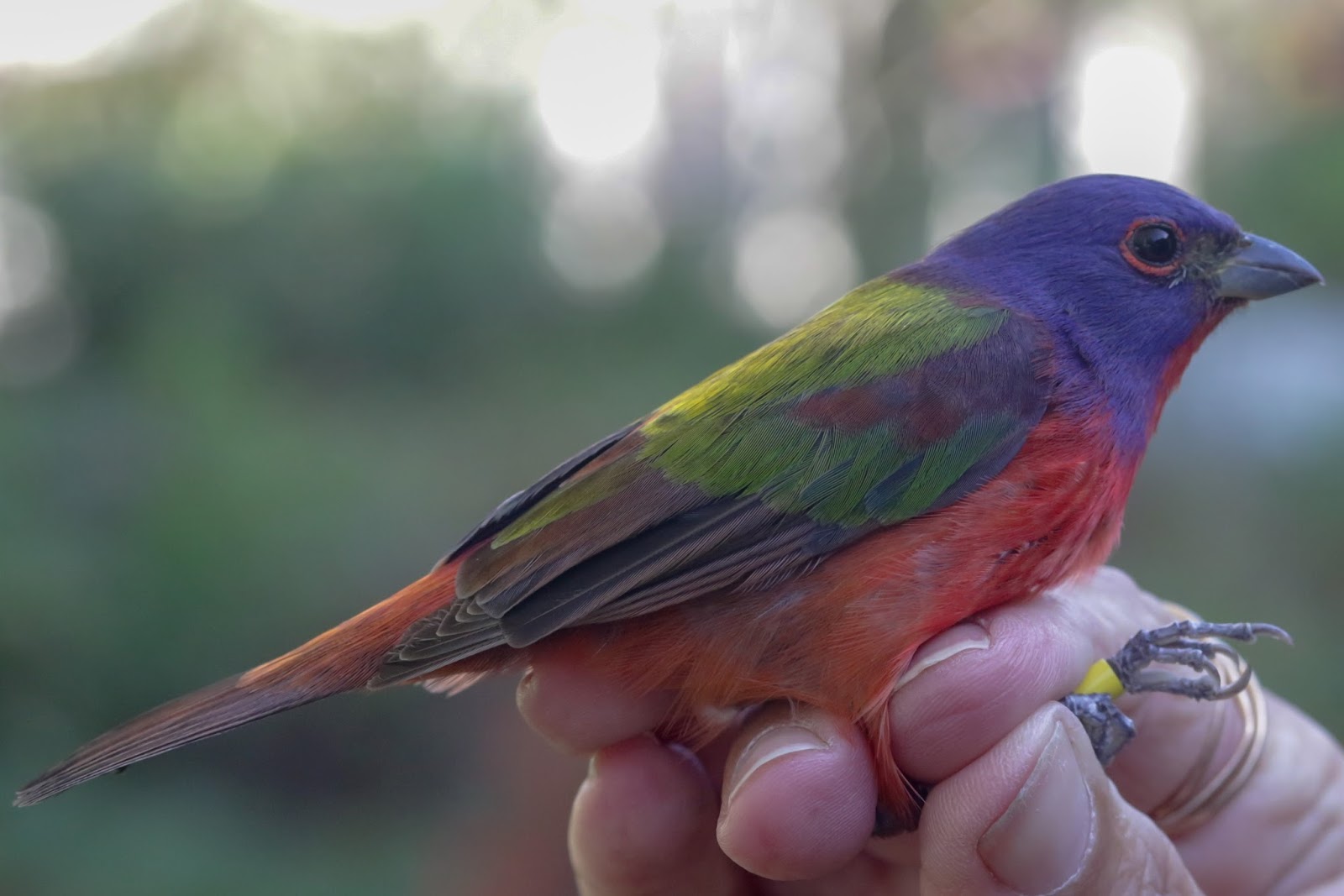
Showing posts with label Blue Jay. Show all posts

Friday, April 20, 2018

April 7, 8, and 9, 2018

The end of Painted Bunting Season 5 approaches and we have gone all out to finish it.  Three days of Painted Bunting banding and then Possum Long (next entry). 

On April 7 we went to a new host site, PB76.  We didn't have many new hosts this season but we still did well.  At this site we banded six new Painted Buntings as well as a Northern Cardinal and a Common Grackle.  After leaving, our host sent a photo to show there were still unbanded birds around.  Having unbanded birds is still data as now we know there were really more birds than the host initially reported. 

unbanded Painted Bunting at feeder at new host site
Photo by host

On April 8 we made our last visit back to PB 46.  We have banded so many buntings and other incidental captures here.  It is such a wonderful place to be.  We banded 9 more Painted Buntings and recaptured 3 from past seasons.  One Painted had a very blue cast, the colors have not been enhanced here.  There was also one with a bit of body molt.  You can see how replacing incidentally lost feathers might create some of the odd color patches we see. 

Painted Bunting with odd blue color look to the feathers

Painted Bunting growing in some replacement feathers

Incidental captures included a Prairie Warbler, 5 Indigo Buntings, 3 Northern Cardinals, 1 Gray Catbird, 6 Blue Jays, and a recently fledged Mourning Dove.  You can see the edged feathers on the wing of the dove.

Prairie Warbler
Photo by Bill LaFramboise

Mourning Dove - hatch year
Photo by Bill LaFramboise

On April 9 we returned to PB70 where there was a caged feeder that was new this season.  These large feeders wrapped in 1 x 2 fencing allow us to use traps to capture more.  We banded 13 new Painted Buntings and recaptured 1 from last season.  We also banded an Indigo Bunting, a Northern Parula, and a Northern Cardinal.  We thoroughly enjoyed 7 students who we introduced to our project.  We were impressed with their knowledge, interest, and participation.  

Indigo Bunting
Photo by Bill LaFramboise

Now on to the finish of Season 5 and migration banding.

Thursday, April 5, 2018

April 4 and 5, 2018 ANOTHER SC!!!

On Wednesday, we returned to PB6 at Dupuis Management Area.  The feeders there were pretty quiet but we did manage to band a new Painted Bunting and recapture 5 more.  This return data is very important to document continued presence and returns to the same location.  We also banded a Northern Cardinal.

Painted Bunting - male
Photo by Bill LaFramboise

On Thursday, we returned to PB62.  It had been two years since we had been here so there were many unbanded birds.  In addition, nearby "natural" or vegetated lots had been cleared so maybe they had moved here for shelter and food.  We banded a whopping 34 new Painted Buntings.  We also recaptured 2 from two years ago.  Incidental captures included 6 Northern Cardinals, a Blue Jay. and a remaining Chipping Sparrow.

Blue Jay
Photo by Bill LaFramboise

But the best news of all was a recapture that totally surprised us in so many ways.  In the net we saw color bands but no split band.  If you've been following all along you know that all of the color banded buntings we band have gotten either a split black/white band or a yellow/green one.  It could have just lost the split one but when we looked it up in our data the band number didn't match any of ours.  Yes, another recapture from elsewhere,

recaptured 10 year old Painted Bunting

The new reporting site for banded birds at the Bird Banding Laboratory (BBL) is now almost instantaneous!  We submitted the band number and got a warning - "caution check data - bird or band is old". Well, the data was fine so we submitted it.

The bird was banded July 1, 2009 near Seabrook Island, SC.  The data said that it was aged to have been hatched in 2008.  We recaptured a ten year old Painted Bunting! He was in very good shape so hopefully he lives on.  Looking at age records determined by banding the oldest Painted Bunting was 12 years old.  The oldest we had recaptured before was 8.  There is a record of one in captivity that was 17 but definitely did not have the same living conditions.

Painted Bunting total to date is 323.  Two or three more sites to go in the next week. 

Next scheduled Possum Long Banding will be on April 10.  Nets go up at sunrise.


Tuesday, March 27, 2018

March 24, 25, and 27, 2018 - SC bird!

Ok, so today is a three-for-one post.  We spent Saturday and Sunday at two very loyal Painted Bunting host locations.  Both had banding sessions earlier but still had unbanded birds. 

On Saturday we returned to PB 5.  We had brought this host a caged feeder much like the one on the Encouraging Painted Buntings Page on this blog.  It fits our traps so we were anxious to see how things were going.  We banded 3 new Painted Buntings and likely would have caught more but the Northern Cardinals thought it was their turn  We banded 6 cardinals and recaptured one.  We also banded 3 Indigo Buntings, a Common Ground-Dove, 2 Blue Jays and 2 Mourning Doves.

After a little while we also set up a net away from the caged feeder.  Good thing we did!!  We caught a Painted Bunting that we had not banded.  We reported this bird to the Bird Banding Laboratory where all banding data is stored/processed/analyzed.  The initial report was that the bird was banded in South Carolina in fall of 2015 as a young bird.  It is still green and we observed feathers that told us that it was an adult bird - a female.  "Foreign" recaptures like this are very rare.  The bird did not have any color bands and is likely NOT one of the ones from the breeding research being done in North Carolina.  We are anxiously waiting more information from the bander.

Indigo Bunting (SY) as told by the small dark feathers over the thumb

Indigo Bunting (ASY) as told by the blue edged small feathers over the thumb
Photos by Bill LaFramboise

Northern Cardinal - female with brood patch

The Indigo Buntings were a great illustration of aging this species.  The first photo is a SY (second year) bird born last summer.  The second is an ASY (After Second Year) adult.  Both are males.  

The cardinal is showing a brood patch and is likely nesting or possibly feeding nestlings.  The belly feathers are gone, the skin is swollen but likely diminishing as it has a wrinkled instead of a blistered appearance.  The brood patch forms to warm the eggs in the nest.  

On Sunday we returned to PB 27.  We banded 11 Painted Buntings.  One was so colorful that the host named it Joseph (and his coat of many colors).  The yellow feathers are a tad unexpected and even his tail was pretty colorful.  We banded 11 Painted Buntings and recaptured 4 from previous seasons.  (Yes, they do come back!)


Painted Buntings
Photos by Bill LaFramboise

On Tuesday we banded our scheduled session at Possum Long.  It was quite windy and the birds were either absent or really hunkered down.  We recaptured a Northern Cardinal and a Painted Bunting.  We also banded one new Gray Catbird.  We stayed long enough to talk with a visiting school group and then we closed up.  Year-round residents were there, a few Great Crested Flycatchers were back for the nesting season, and the only warbler seen was 1 Prairie Warbler. 

Next Possum Long banding will be April 3, 2018.  Nets go up at 6:45.

Tuesday, March 20, 2018

March 18, 2018

On the 18th we returned to PB 10 which was one of our Season One sites.  It was a very quiet visit but still fun and informative.

We banded two new Painted Buntings.  We also had three recaptures which give us a lot of information.  One recapture was a male that we banded almost a year ago.  It was a young, green bird at that time but now shows its beautiful male plumage.  It was exceptionally bright and had a scattering of unexpected yellow patches on the breast and undertail.  We have seen this a lot but it is great to know the age of this bird (in its third year as banders add a year to ages in January).  Sometimes color changes are attributed to older birds but this one is on the young side.


male Painted Bunting with extra yellow feathers

We also had incidental captures of a Blue Jay and a Black-and-white Warbler.  The Black-and-white was born last summer and is just developing the black throat that indicates it is male. It is barely visible in the photo but you can see that for now it looks like a stripe but will become fully black.  

Black-and-white Warbler

Next Possum Long session will be on Tuesday, March 27.  Nets go up at 6:45 am.

March 17, 2018

On Saturday we took a long distance drive to return to PB 61.  It was a great trip!  We banded 14 new Painted Buntings which is a great total for additional visits.  This location has been very good for incidental species and this time was no different.

We banded a Northern Parula that had lost its tail.  It was growing in and all of the feathers were in sheath.  The parula had been feeding at some type of flower as it had pollen on its head.  Birds can be  important pollinators.  You can see the tiny bit of yellow at the base of the bill.


Northern Parulas
Photos by Bill LaFramboise

We also banded a Blue Jay, a Common Grackle, an Indigo Bunting (only second one the hosts had ever observed in their yard), and a Palm Warbler.

One other fun incidental was a female Summer Tanager.  We suspect that this bird was feeding on bees that were in a nest box in the yard.

Summer Tanager
Photo by Bill LaFramboise

Next Possum Long session will be on Tuesday, March 27.  Nets go up at 6:45 am.


Thursday, March 15, 2018

March 5, 2018

My how time flies and I have four more updates to catch up on.  On March 5 we went to a new location,  our 75th!  I must say that all of our hosts have been so fun to meet.  This time was no different.  The habitat of this yard supported many buntings as well as so many butterflies.  It is good to meet kindhearted folks like here.

This location is within a half mile of another site as the bird flies but a bit farther by road.  There is a little water separating the two but it will be great to see if these two locations share birds!

We banded 12 Painted Buntings and had 7 incidentals.  A Northern Parula was first catch and was a treat as always.

Northern Parula
Photo by Bill LaFramboise

Painted Bunting (male)
Photo by Bill LaFramboise

Other incidentals included a Gray Catbird, a Northern Cardinal, 2 Blue Jays and 2 Common Grackles.

On our way home we went to Loxahatchee NWR to check on a Vermilion Flycatcher that has over wintered.  It was nice to see how much more red it has than it did in November.

Vermilion Flycatcher
Photo by Bill LaFramboise

This is a catch-up post.  Next Possum Long Banding will be listed on the March 13th entry.


Friday, March 2, 2018

February 28, 2018

On Wednesday we returned to PB 65.  It was a a terrific session with a surprise.  Not a new bird this time but quite a treat.

We banded 9 Painted Buntings.  We had time to get several great photos.

Painted Bunting - male
Photo by Bill LaFramboise

Painted Bunting
Photo by Bill LaFramboise

In addition to the 9 buntings we banded 2 Blue Jays and recaptured a Northern Cardinal from last year.

Among the 9 buntings was our surprise.  I have never seen this coloring on a Painted Bunting before.  It is NOT molting so it is not turning male.  In fact the feathers tell us it is an adult and the wing length suggests that is male.  So, an adult male with odd colors.  Next one thinks of things that might change feather coloring including genetic "mistakes" that either change the colors themselves or the hormones that help determine color.  What is hard to fathom is that the blue color on males' heads is not due to pigment.  The blue color on birds is made by changing light.  It is a complex mix of reflection, refraction, and feather structure.  So did the feather structure get changed?  It is certainly less red than a typically colored male.


Photos by Bill LaFramboise

This bird has sparked a lot of discussion.  I will be trying to find out more about this coloration.


Sunday, February 25, 2018

February 19, 2018

On February 19 we returned to PB 5.  It is one of the few locations where a very close neighbor is also feeding Painted Buntings.  We set up in both yards.  Despite the wind, we managed to band quite a few birds including 4 Painted Buntings and 1 Indigo Bunting.  We have come to this location every year in the study and it is always a pleasure! 

male Painted Bunting
Photo by Bill LaFramboise

Indigo Bunting (young male)
Photo by Bill LaFramboise

One of the missions of a bander is to educate and inspire.  The host at PB5 invited her grandchildren and we had a very good time talking about birds and butterflies.  One can hope that our mission was accomplished.  Hi to these young ladies and we hope you enjoy reading about the birds you saw banded.

Pete Grannis showing the girls what we do - Photo by Grandma

I love that children are so interested!  - Photo by Grandma

We also captured a few incidental birds.  We banded 4 Red-bellied Woodpeckers and really enjoyed aging these, 1 Blue Jay, and 1 Mourning Dove. 3 Northern Cardinals, and 1 Pine Warbler.

Pine Warbler
Photo by Bill LaFramboise

Mourning Dove
 Photo by Bill LaFramboise

Red-bellied Woodpeckers - comparing 2 wings
Photo by PB5 host

Blue Jay
Photo by PB5 host

February 16, 2018

I'm behind on a few posts so be sure to read the next few!

On February 16, we went to PB 6 to band.  We caught a good number of buntings though there are more to catch.  We banded 9 Painted and 11 Indigo Buntings.  It seems when Indigos are present they are bolder and get caught first. 

Indigo Bunting
Photo by Bill LaFramboise


Indigo Bunting (young male)
Photo by Bill LaFramboise

Painted Bunting molting in 2 head feathers
Photo by Bill LaFramboise

Though the above photo shows head feathers being replaced, for the most part Painted Buntings do not do much molting in the spring.  They may replace a few head feathers to "spiffy up" or to just replace what has been lost.  (In other words, please remember, male colors are only developed in the fall!)

We also banded EIGHT Blue Jays, 1 Palm Warbler, 1 Chipping Sparrow, 1 Northern Cardinal, and 2 Gray Catbirds.

Blue Jay
Photo by Bill LaFramboise

Chipping Sparrow
Photo by Bill LaFramboise


Friday, February 9, 2018

January 26 & February 7; February 6

Since the last post we have made 2 visits to PB 73 where we had loaned the host a caged feeder.  (Nets were unproductive on our first visit.)  It took a while for the buntings to trust the feeder but it was worth the wait.  We banded a total of 11 Painted Buntings, plus an incidental Common Grackle, 1 Red-winged Blackbird, and 2 Northern Cardinals. 

Common Grackle
Photo by Suzanne Zuckerman

Painted Bunting (male with some yellow coloring on the undertail)
Photo by Suzanne Zuckerman

Red-winged Blackbird
Photo by Suzanne Zuckerman

The Red-winged Blackbird was a female with a lot of reddish coloring on the face and throat.  This indicates it is likely an older female.  Other data supported the adult classification.  

Many thanks to this gracious and dedicated host.

Red-winged Blackbird
Photo by Suzanne Zuckerman

On February 6 we returned to PB 67 just about a week later than when we went last year.  This yard and host is  a joy to visit - birds and enthusiasm.  Being 2 hours north gave us a little different variety.  Last year we caught our only Tufted Titmouse here.  Within seconds of putting up the nets we caught number 2.  

Tufted Titmouse
Photo by Bill LaFramboise

The rest of the day was consistently busy.  We beat last year's 21 birds by banding 22 plus we recaptured 2 from last year.  

young Painted Bunting
Photo by Bill LaFramboise

This particular bunting had undertail coverts with darker centers.  

Painted Bunting
Photo by Bill LaFramboise

In addition to the titmouse we had 12 additional incidentals.  Eight Northern Cardinals kept us watching out for our fingers.  A Common Grackle, 2 Blue Jays, and the surprise of the day rounded out the captures.

Our host had told us he had a different sparrow so we were hopeful that it would be caught.  It turned out to be a White-crowned Sparrow - a bird I had studied in Washington as part of a site fidelity study.  This was a different subspecies but it was nice to have "in-hand" again.  This subspecies has a dark lore (the area between the beak and eye) while the one in WA has no black there.  This is an immature bird as told by the reddish brown and tan crown stripes but it is starting to fill in the black and white stripes of adulthood.  

White-crowned Sparrow
Photo by Bill LaFramboise

We are starting our "spring" banding at Possum Long on Tuesday, February 13.  Net go up at 7 am.  Regular sessions will continue on Tuesdays.  We will see what shows up this early (likely still "winter" birds) but we can hope migrants appear soon.