Showing posts with label Gray-cheeked Thrush. Show all posts

Thursday, October 19, 2017

October 16, 2017

On Monday we caught more bigger birds than warblers.  We did catch 1 American Redstart and TWO more Magnolia Warblers but the rest of the captures were big.  It has been hard to believe how many Magnolia Warblers are around and being captured.

We caught a good variety of the bigger birds:  Our second only Scarlet Tanager.  The white underwings are created by the flight feathers being half white and half black.  The black shows on the upper wing and the white shows on the underwing.  This is not the case with the similar Summer Tanagers.  This bird was missing its tail.  There were signs of it already growing back in. 

Scarlet Tanager

Scarlet Tanager

We also caught 3 thrushes:  2 Gray-cheeked and one Swainson's.  This Gray-cheeked does not show the spectacle that the Swainson's does.  It was carefully measured to rule out the smaller Bicknell's Thrush.

Gray-cheeked Thrush

We rarely capture Rose-breasted Grosbeaks but they had been on the property for several days and were feeding on figs, palm berries, and beautyberry fruit.  Last year when we caught another one it was feeding on beautyberry. 

Rose-breasted Grosbeak

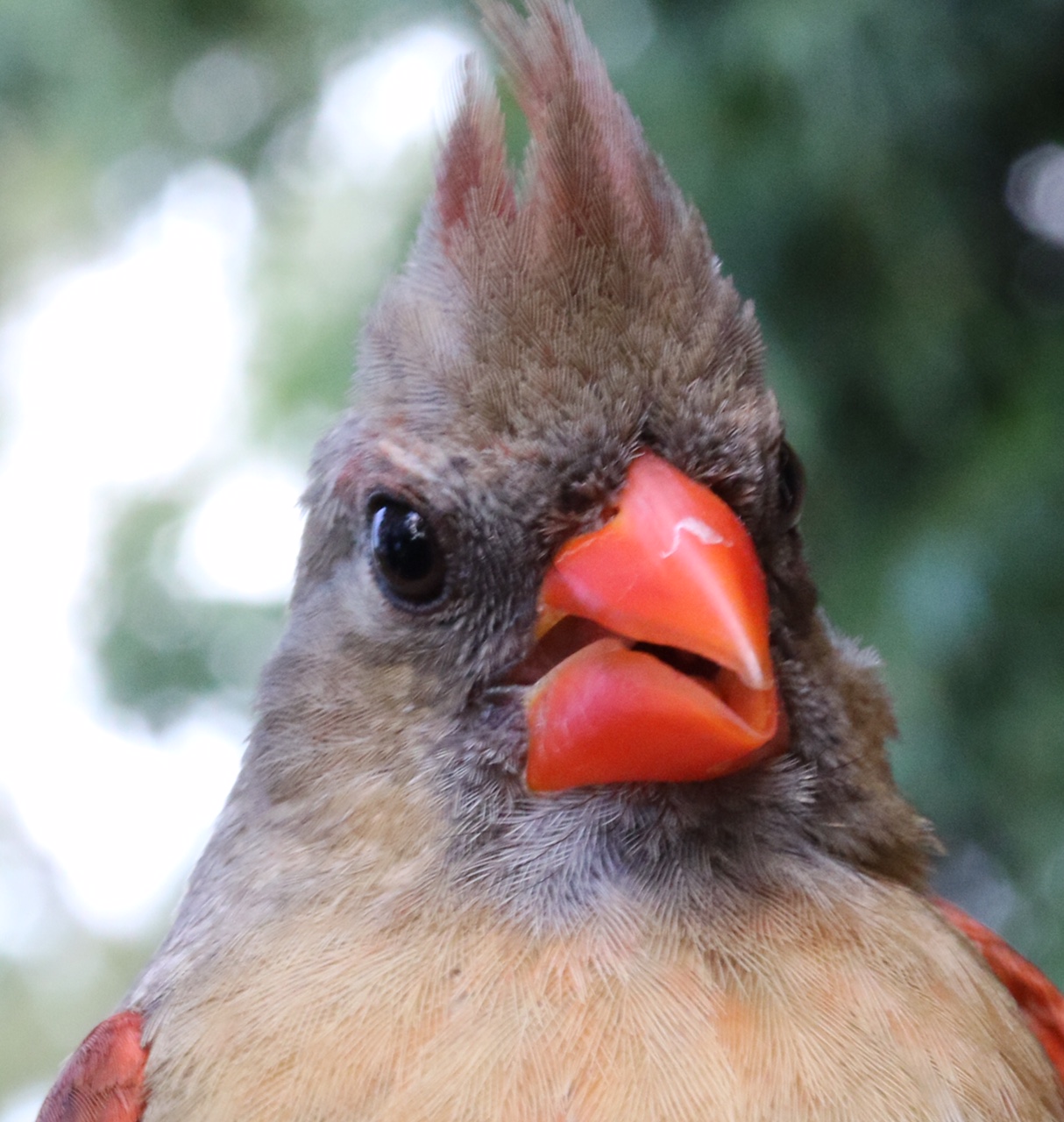
The other birds caught and banded were 1 Brown Thrasher, 2 Gray Catbirds and 1 Northern Cardinal.

Note for next scheduled session is on the next post.


Monday, October 2, 2017

September 30 and October 1, 2017

We did a little extra banding this weekend since it is migration time.  We banded at Possum Long on Saturday and at PB 46 on Sunday.  Saturday was productive but a bit slower than last Tuesday's session.  We banded 13 birds (8 species) and saw a few that went no where near the nets.  These were the first of season Cape May Warbler, several Scarlet Tanagers, a Northern Parula, and a Summer Tanager.

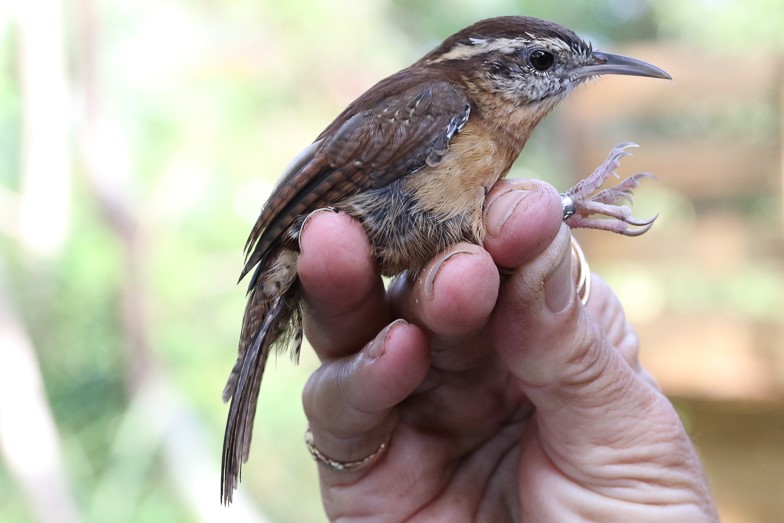
We banded 4 Black-throated Blue Warblers, 3 Ovenbirds, and one each of Red-eyed Vireo, Carolina Wren, Swainson's Thrush, Gray-cheeked Thrush, Northern Cardinal, and Gray Catbird.  Of these the thrushes made their first welcome appearance.  We should get more this month.  The Red-eyed Vireo was a young bird so it did not yet have a bright red eye.  It was the fifth one of this species for the property.  The Carolina Wren was only the second one on the property. 


Red-eyed Vireo

Carolina Wren
Photo by Bill LaFramboise

Gray-cheeked Thrush
Photo by Bill LaFramboise

Swainson's Thrush
Photo by Bill LaFramboise

At PB 46 we were pleased to catch some of their early Painted Buntings.  They estimated they had at least 10-15 birds back.  Three were previously banded.  We caught 5 new green Painteds.  we used our new split band - so be on the lookout for yellow/light green bands.

Painted Bunting with new split band color
Photo by Bill LaFramboise

One of the buntings was a very young bird.  Just out of the nest Painted Buntings, both male and female, are green and brownish.  They molt in the fall like the adults but ALL of the youngsters stay green.  They do not molt much until the next fall (about 15 months) and this is when the male birds acquire their pretty colors.  

Earlier in the season, these hosts had a 2nd year male bird starting to grow in the bright feathers.  We had received other photos just before Bob sent this one.  It is the first time we had photos of this particular change!!

Painted Bunting male acquiring its first bright feathers (approximatley 15 months old)
Photo by Bob Ellis


Back to the youngster, you can see in the photo below that it was heavily molting and that it still had some of the juvenal brownish feathers.  (Arrow)

Very young Painted Bunting with juvenal feathers
Photo by Bill LaFramboise

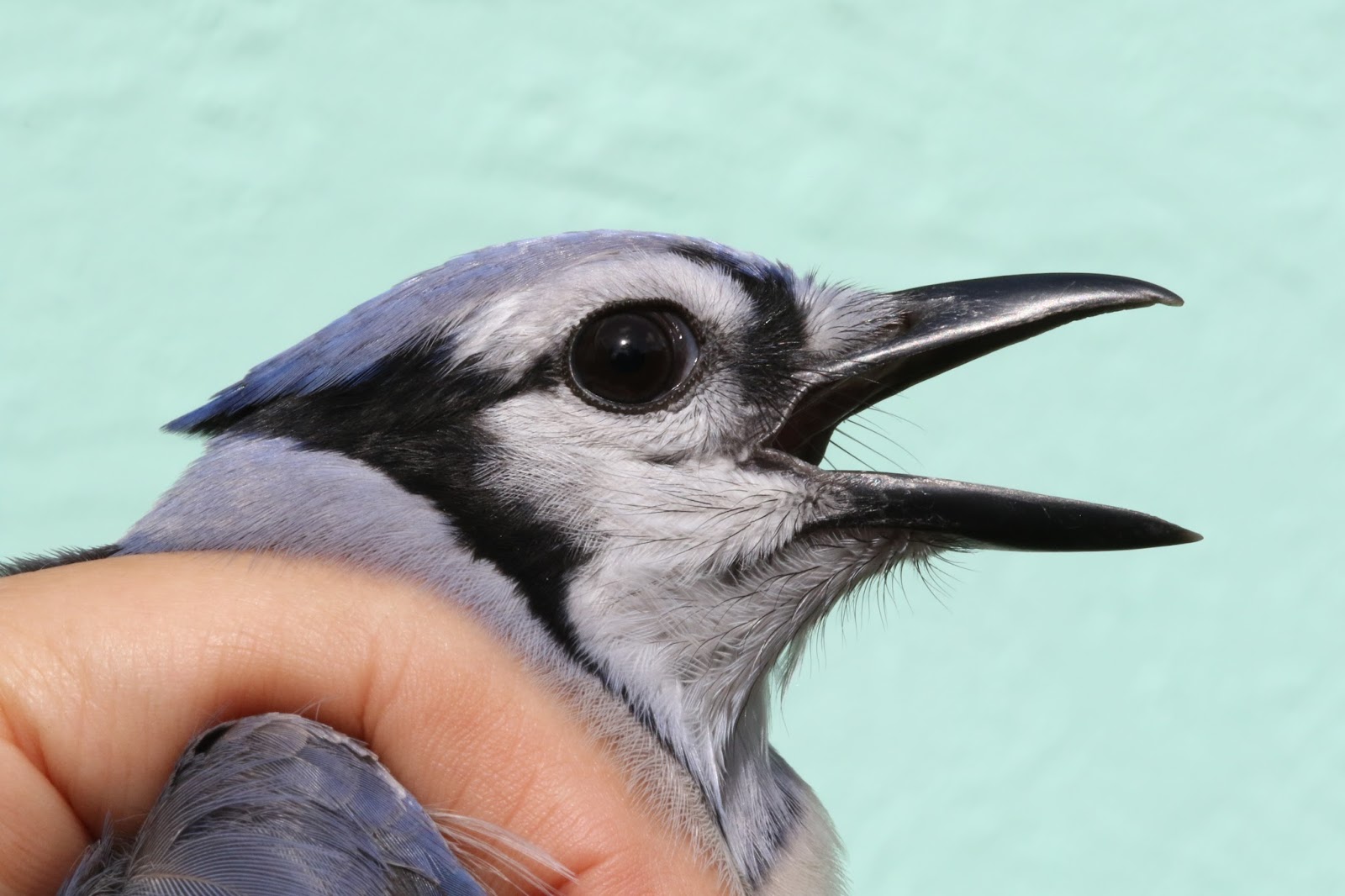
We also caught another Red-eyed Vireo as well as several Blue Jays, several Common Grackles, and a Northern Cardinal.  

Blue Jay
Photo by Bill LaFramboise

Common Grackle
Photo by Bill LaFramboise

We will band at Possum Long tomorrow, October 3.  Nets go up at 7 am.  It could be windy so hopefully the more sheltered nets won't blow.  If they do, we will close early.


Monday, May 1, 2017

April 25, 2017 and a few more

April 25 will likely go down in the record books for numbers of birds.  Winds favorable for seeing migrants finally arrived and I was out of town!  Permit holder Pete Grannis with support from Jim and Roy banded a total of 24 birds:  12 Black-throated Blue Warblers, 3 Ovenbirds, 2 Gray-cheeked Thrushes, an Indigo Bunting, a Common Yellowthroat, a Veery, a Swainson's Thrush, a Gray Catbird, an American Redstart, and a Black-and-white Warbler.  My thanks to this crew who made it possible to not miss this wave of birds.  There might be more western winds later this week and we will be out there Tuesday or not!

Indigo Bunting
Photo by Pete Grannis

Black-throated Blue Warbler
Photo by Pete Grannis

Ovenbird
Photo by Pete Grannis

Black-and-white Warbler
Photo by Roy Netherton

Gray-cheeked Thrush
Photo by Roy Netherton

Our other permit holder, Bill LaFramboise, ran two sessions (April 22 and April 28) even though winds were not as favorable.  Several Northern Cardinals were banded as was a Gray Catbird and our final Painted Bunting.

Gray Catbird
Photo by Bill LaFramboise

Painted Bunting (SY)
Photo by Bill LaFramboise

Northern Cardinal
Photo by Bill LaFramboise

So, there should be a few more sessions at Possum Long and then we will break for the summer and see you all again sometime in August.  A future post will let you know when.

Next Possum Long Session will be on Tuesday, May 2.  Nets open at 6:45.  Remember pouring rain will delay or cancel a session.

Monday, October 10, 2016

October 9, 2016 and a bit from October 2


October 11 Banding cancelled  -See you on October 18


Last post I forgot to include some photos from our previous weekend session.  On October 2, we caught five birds.  Most exciting was our first Eastern Screech-Owl.  We had one in the net previously but did not have the proper band.  This time we were ready.  The bird was a red morph and was recently born.  It's feathers were still early ones, not downy but still fluffy.  This gave our bird a "stuffed animal" look.

Eastern Screech-Owl

Had it not been for the owl, our top bird would have been a Hooded Warbler.  Unfortunately we only got wing and tail shots of this species.  Other birds caught were a Veery, a Gray-cheeked Thrush and an Ovenbird.  The Veery was quite interesting with some white feathers in both wings and a lost tail.  We recaptured this same Veery on 10/9 and the tail was growing in.  The white feathers were on both wings so not from some type of injury.

Gray-cheeked Thrush

Veery

October 9 was quite exciting,  We recaptured a Painted Bunting that was banded as a young, green bird in March and now shows its male colors.  We also saw a banded green.  The buntings are returning!!!

We banded a total of 14 birds and had 4 recaptures (the Painted Bunting, the Veery, and 2 Ovenbirds).  

The Gray Catbirds are back!  We banded three.  We also banded 2 of their close relatives - Northern Mockingbirds.  The photo below is of a young mocker.  Its eyes are not yet intensely yellow.  We suspect the beautyberry near one net is now ripe.  We haven't had mockingbirds recently.  We also caught a third mockingbird but released it unbanded.  It was not a healthy bird, possibly having avian pox.  

Northern Mockingbird

Two White-eyed Vireos were exciting and a great comparison of eye color.  The young one was still more gray than white-eyed.  

White-eyed Vireo

We also had another Northern Cardinal, also young as were most of the recent birds.  They must have had a great nesting season.  

Northern Cardinal

In the warbler category we did quite well.  We banded two  Ovenbirds, a Common Yellowthroat, two Black-throated blue Warblers, and a first for the property, Blue-winged Warbler!

Blue-winged Warbler

Next banding session: To be determined, hopefully October 18.  Do not park on Hibiscus.  The dead pine tree has been dropping branches.  High winds may also cancel this session.

Saturday, October 1, 2016

October 1, 2016 Migration bliss

Due to approaching weather (Hurricane Matthew), multitudes of great migrant reports, and many good birds at Possum Long yesterday, I decided to run a session today.  Well worth it!  We saw 27 species (many migrants including a bunch of Cape May Warblers) and banded 14 birds (8 species) and recaptured 2 more.

Once again we banded Swainson's Thrush - three of them.  There were more unbanded ones viewed.

Swainson's Thrush

We also banded three more Ovenbirds.

Ovenbird

One of the species banded early in the morning was a Northern Parula.  This is a young bird with the typical red and/or slate breast band are not developed.  The wing bars and yellow lower bill are visible.  

Northern Parula
Photo by Robin Potvin

A very big surprise was a Swainson's Warbler.  The previous ones (only 3!) we banded were in September.  Upon returning home I read that there was one banded in Georgia today so maybe more will be coming through.  

Swainson's Warbler
Photo by Robin Potvin

The Worm-eating Warbler we banded was a good species to compare with the Swainson's Warbler. The central crown stripe and bill size look quite different.

Worm-eating Warbler

Today was a "three species of thrushes" day.  In addition to the Swainson's Thrush above, we banded a Veery and a Gray-cheeked Thrush.  The Gray-cheeked measured beyond a doubt to be well out of the range of Bicknell's Thrush.  The Veery, below, shows the classic red/rufous color of this species.  

Gray-cheeked Thrush

Veery

The last species banded was Black-throated Blue Warbler.  Banding three of them made for nice age and subspecies comparisons.  Two of the birds were adult males, the other was a young bird.  Two were the Appalachian subspecies (black marking on the back) and one was from the non-Appalachian population.

Black-throated Blue Warbler

Black-throated Blue Warbler
Appalachian subspecies
Photos by Robin Potvin

Our recaptures were exciting.  Both had been banded in September, 2013 as hatch-year birds.  So both are three years old.

White-eyed Vireo

Blue Jay

Next banding:  Tuesday, October 4, but Hurricane Matthew may cancel this session.  Email keepbirding2@yahoo.com if you want to be notified of session status.  If clear, nets go up at 6:45 am.  


Tuesday, October 27, 2015

October 27, 2015 Bunting Busy

This will be short & sweet but I will add more later.

The caged feeders for the Painted Bunitngs appear to be working.  We banded 4 green (can't tell female or first-year male) Painted Buntings today.  Some were still loaded with fat and may move on and others were empty.  It will be interesting to have observations to see how long each individual stays.

We also banded another Gray-cheeked/Bicknell's Thrush.  This one had more data that supports Bicknell's but the wing chord was in the overlap range.  We will have to get more information so for now it is one of the two in the overlap range.

We also banded/recaptured 2 Black-throated Blue Warblers, 2 Ovenbirds, 1 Gray Catbird, and 1 Common Yellowthroat.


Above three photos are of a undetermined Gray-cheeked/Bicknell's Thrush
Photos 1 and 2 by Bob Ellis; Photo 3 by Jane Wiewora

Painted Bunting
Photo by Bob Ellis

Next banding:  Tuesday, November 3.  Nets open at 6 am - remember time change!

Thursday, October 8, 2015

October 4, 5, & 6

I was very much hoping that a change in the weather would bring the migrants that most Florida birders are waiting for.  They seem to be held up in the north.  All three days were very quiet and likely we missed the rush by just a few days.

Sunday morning we banded at thrush that had the appearance of a Gray-cheeked Thrush.  Gray-cheeked Thrushes are virtually identical to Bicknell's Thrushes.  To tell them apart there are various measurements that have to be taken.  Bicknell's are the smaller of the two species (and this one seemed small) but there is some overlap in size.   As it turns out, the measurements were in the overlap range of these two species so we still cannot tell which species it is.  It was recorded as a GCBT; a banding code for birds in the overlap zone.

Gray-cheeked/Bicknell's Thrush
Photo by Nancy Price

Gray-cheeked/Bicknell's Thrush - studying the wing and taking measurements
Photo by Nancy Price

We managed to catch a few birds over the three days but most migrants that were around were quite high in the trees.  We are hoping to get a canopy net to use by next spring.

We banded the thrush, a Red-bellied Woodpecker (hatch-year male), 2 Gray Catbirds, and had 2 recaptured Ovenbirds and a recaptured Northern Cardinal.


Gray Catbird
Photo by Nancy LaFramboise

Northern Cardinal - recapture
Photo by Jane Wiewora

One exciting addition to the Possum Long property was a flyover Northern Harrier.  It is now the peak of raptor migration so it was great to see a new bird for the property.

Next regularly scheduled banding:  Tuesday, October 13.  Nets go up at 6:30 am.

Wednesday, September 25, 2013

September 25, 2013

Today we (the two Nancys) couldn't resist trying for more migrants.  It was fairly noisy this morning. Numbers were definitely down but diversity was still fairly high.  One new bird for the property, one new county bird for Nancy Price (Yellow-throated Vireo which we did not catch), and one new banded species for me.

We banded a total of 4 birds today, the now expected Ovenbird and American Redstart, a Gray-cheeked Thrush, and a Scarlet Tanager.  Nancy Price spotted the tanager in the strangler fig when we listened to jays and other birds mobbing this new visitor.

Barred Owl
Photo by Nancy Price

Barred Owl
Photo by Nancy Price

It was fun to see all the attention the birds paid to this owl.  Tiny Blue-gray Gnatcatchers kept buzzing around it.

Prior to the owl we banded a Gray-cheeked Thrush.  Its wing and feather measurements (and bill color) assured us that it was not another Bicknell's Thrush!

Gray-cheeked Thrush
Photos by Nancy Price

The female Scarlet Tanager was caught in a net in the butterfly garden.  We think it may have gone to the bird bath for a drink.    I love the up close photo as you can see the strange bill notch that tanagers have.  The bird was not going to stay still for pictures until it bit me.  Luckily it is nowhere near as painful as a cardinal


Scarlet Tanager
Photos by Nancy Price

We will set up again tomorrow at 7:30 am but may not stay too long if we are not getting birds in the nets.  Hope to see you there.