Showing posts with label Gray Catbird. Show all posts

Friday, April 20, 2018

April 16 and 17, 2018

With weather looking to change on Sunday, we decided to band on Monday as well as our usual Tuesday.  On April 16 it wasn't as birdy as we expected.  We banded 2 Black-throated Blue Warblers, 1 Ovenbird, and 1 Red-bellied Woodpecker.

Ovenbird
Photo by Bill LaFramboise

Red-bellied Woodpecker
Photo by Bill LaFramboise

We did see a few migrants including a pair of Rose-breasted Grosbeaks.  Unfortunately the property lost a lot of flowers during the hurricane so fruit is in short supply.  Birds stayed very high.  It was fun to see a banded Great Crested Flycatcher that returned.  We haven't banded one this spring so we know it has returned for this breeding season.

The weather held true for Tuesday and we did get a few more birds.  Maybe more exciting was what was on the property.  Glad to see these birds that only stay a short time but frustrating to have four species that would have been new to band.  We banded a Northern Parula, an Ovenbird, a Gray Catbird, 3 Black-throated Blue Warblers, and the two highlights:  a Cape May Warbler and our third ever Wood Thrush.

Wood Thrush
Photo by Bill LaFramboise

Cape May Warbler
Photo by Bill LaFramboise

Black-throated Blue Blue warbler
Photo by Bill LaFramboise

Though warblers were still present, the migrants seemed to be represented by larger birds.  Seen were Blue and Rose-breasted Grosbeaks, Summer Tanagers, Red-eyed and Yellow-throated Vireos, and a late Yellow-bellied Sapsucker.  What will come next week?

After Monday's session we made an afternoon visit to PB 3.  The host is not far from Possum Long and we were seeing a good interchange of birds.  It is this location that first showed that Painted Buntings can feed at least 1/2 mile away from where they were banded.  We have seen this at two other locations since.  The host reported a bird with bands that did not seem to match anything we had banded.  Though we did not catch that one we banded 2 new Painted Buntings.  Our Season 5 has ended unless we catch another one at Possum Long.  We banded 355 this season which ties our high of Season 4.

Next scheduled banding at Possum Long will be on April 24.  Nets go up at 6:30.

April 7, 8, and 9, 2018

The end of Painted Bunting Season 5 approaches and we have gone all out to finish it.  Three days of Painted Bunting banding and then Possum Long (next entry). 

On April 7 we went to a new host site, PB76.  We didn't have many new hosts this season but we still did well.  At this site we banded six new Painted Buntings as well as a Northern Cardinal and a Common Grackle.  After leaving, our host sent a photo to show there were still unbanded birds around.  Having unbanded birds is still data as now we know there were really more birds than the host initially reported. 

unbanded Painted Bunting at feeder at new host site
Photo by host

On April 8 we made our last visit back to PB 46.  We have banded so many buntings and other incidental captures here.  It is such a wonderful place to be.  We banded 9 more Painted Buntings and recaptured 3 from past seasons.  One Painted had a very blue cast, the colors have not been enhanced here.  There was also one with a bit of body molt.  You can see how replacing incidentally lost feathers might create some of the odd color patches we see. 

Painted Bunting with odd blue color look to the feathers

Painted Bunting growing in some replacement feathers

Incidental captures included a Prairie Warbler, 5 Indigo Buntings, 3 Northern Cardinals, 1 Gray Catbird, 6 Blue Jays, and a recently fledged Mourning Dove.  You can see the edged feathers on the wing of the dove.

Prairie Warbler
Photo by Bill LaFramboise

Mourning Dove - hatch year
Photo by Bill LaFramboise

On April 9 we returned to PB70 where there was a caged feeder that was new this season.  These large feeders wrapped in 1 x 2 fencing allow us to use traps to capture more.  We banded 13 new Painted Buntings and recaptured 1 from last season.  We also banded an Indigo Bunting, a Northern Parula, and a Northern Cardinal.  We thoroughly enjoyed 7 students who we introduced to our project.  We were impressed with their knowledge, interest, and participation.  

Indigo Bunting
Photo by Bill LaFramboise

Now on to the finish of Season 5 and migration banding.

Wednesday, April 4, 2018

March 30, April 2 and 3, 2018

Painted Bunting banding is progressing and we are nearing the end of Season 5.  Even Possum Long was pretty much about Painted Buntings.

On March 30 we returned to PB 37.  We are very thankful that this host was willing to let us come on short notice when someone else had to cancel.  It was a very good session and we banded 10 buntings.  Our host is a wonderful photographer (award winning!) and I am including her photos below!

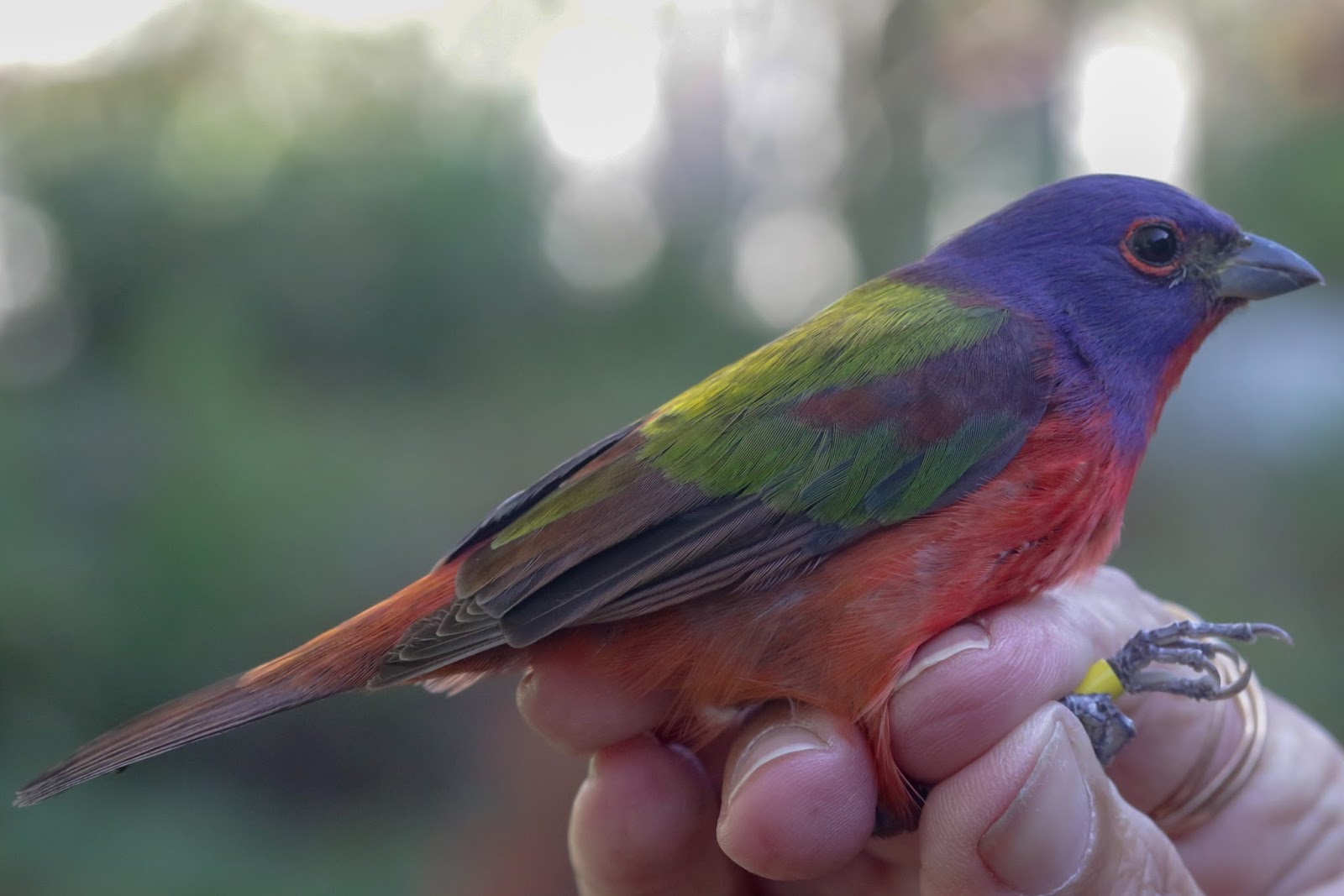
Painted Bunting - male
Photo by Susan Faulkner Davis

Though we banded those 10 and recaptured one, this one was not caught but was sighted later at the bath!  More good data!

resighting of a male Painted Bunting
Photo by Susan Faulkner Davis

We also banded incidental captures including 3 Common Grackles, a Red-bellied Woodpecker, and a surprise recently fledged Northern Mockingbird.  Note the spotted breast and the fleshy gape where the upper and lower bill are joined.  Its tail was still growing in.

Red-bellied Woodpecker
Photo by Bill LaFramboise

Northern Mockingbird
Photo by Bill LaFramboise

On April 2, we returned to PB 3.  This site is very close to Possum Long as the bird flies and it is one of several locations where we have shown that Painted Buntings will use feeders over 1/2 mile away from each other.  We recaptured a bird that was banded at Possum Long this past fall.  We also banded 5 new buntings. and recaptured another from a previous season.  

At our regular session at Possum Long on April 3 we banded two new Gray Catbirds.  They will be leaving very soon.

Gray Catbird wing
Photo by Bill LaFramboise

We also recaptured 3 Painted Buntings.  Two had been banded on February 19, 2017.  Always nice to prove that these birds return.  One was originally ID'd as a female and of course it still is, but she was developing a redder color on the underside which we sometimes see.  We have been told this likely indicates and older female.

older female Painted Bunting

The third one had been banded at PB 3 during Season ONE, February 19, 2014!  It was young and green at the time and now shows its male colors.  It had not ever been resighted by us at Possum Long or by the host at PB 3.  A lot of people are skeptical when birds don't "return" and it is hard to say whether they keep moving, feed elsewhere, or are are just not observed.  Here's a bird that is now 5 years old that has been "rediscovered"!

Next Possum Long regularly scheduled banding will be on April 10.  Nets go up at or just before sunrise.  


Tuesday, March 27, 2018

March 24, 25, and 27, 2018 - SC bird!

Ok, so today is a three-for-one post.  We spent Saturday and Sunday at two very loyal Painted Bunting host locations.  Both had banding sessions earlier but still had unbanded birds. 

On Saturday we returned to PB 5.  We had brought this host a caged feeder much like the one on the Encouraging Painted Buntings Page on this blog.  It fits our traps so we were anxious to see how things were going.  We banded 3 new Painted Buntings and likely would have caught more but the Northern Cardinals thought it was their turn  We banded 6 cardinals and recaptured one.  We also banded 3 Indigo Buntings, a Common Ground-Dove, 2 Blue Jays and 2 Mourning Doves.

After a little while we also set up a net away from the caged feeder.  Good thing we did!!  We caught a Painted Bunting that we had not banded.  We reported this bird to the Bird Banding Laboratory where all banding data is stored/processed/analyzed.  The initial report was that the bird was banded in South Carolina in fall of 2015 as a young bird.  It is still green and we observed feathers that told us that it was an adult bird - a female.  "Foreign" recaptures like this are very rare.  The bird did not have any color bands and is likely NOT one of the ones from the breeding research being done in North Carolina.  We are anxiously waiting more information from the bander.

Indigo Bunting (SY) as told by the small dark feathers over the thumb

Indigo Bunting (ASY) as told by the blue edged small feathers over the thumb
Photos by Bill LaFramboise

Northern Cardinal - female with brood patch

The Indigo Buntings were a great illustration of aging this species.  The first photo is a SY (second year) bird born last summer.  The second is an ASY (After Second Year) adult.  Both are males.  

The cardinal is showing a brood patch and is likely nesting or possibly feeding nestlings.  The belly feathers are gone, the skin is swollen but likely diminishing as it has a wrinkled instead of a blistered appearance.  The brood patch forms to warm the eggs in the nest.  

On Sunday we returned to PB 27.  We banded 11 Painted Buntings.  One was so colorful that the host named it Joseph (and his coat of many colors).  The yellow feathers are a tad unexpected and even his tail was pretty colorful.  We banded 11 Painted Buntings and recaptured 4 from previous seasons.  (Yes, they do come back!)


Painted Buntings
Photos by Bill LaFramboise

On Tuesday we banded our scheduled session at Possum Long.  It was quite windy and the birds were either absent or really hunkered down.  We recaptured a Northern Cardinal and a Painted Bunting.  We also banded one new Gray Catbird.  We stayed long enough to talk with a visiting school group and then we closed up.  Year-round residents were there, a few Great Crested Flycatchers were back for the nesting season, and the only warbler seen was 1 Prairie Warbler. 

Next Possum Long banding will be April 3, 2018.  Nets go up at 6:45.

Tuesday, March 20, 2018

March 19, 2018

Our last Possum Long session hints that migration may be picking up.  We had a lot of visitors including a preschool group, a smart young lady who was on spring break, and new and old friends.  I am thankful for my long term volunteers and the visitors who allow me to share this experience.

We banded 6 birds and recaptured 2.  The recaptures were a Gray Catbird from March of 2014 and a Painted Bunting from this past fall.  Hopefully their return to this location met their "fuel" needs as they overwintered somewhere and are getting ready to depart.

We banded our first Prairie Warbler of the season.  Although some over-winter here, we suspect (hope?) that this one was migrating through.  It was starting to build up some fat reserves to fuel its journey north.  Hard to see in the field but visible in hand are the rufous streaks on the back of this species.


Prairie Warbler
Photos by Bill LaFramboise

We also banded two other warblers:  a Yellow-rumped and a Palm.  These are winter residents in south Florida but still might be stopping at Possum Long.  The Palm Warbler was starting to develop its breeding colors - its rufous cap and yellower face and breast.

Palm Warbler
photo by Bill LaFramboise

We also banded three new Gray Catbirds.  Another capture was a male Northern Cardinal that we were unable to band.  It likely had a mite infestation that was causing its legs to enlarge.  We do not feature some of the injuries and illnesses we see but this one is pretty common especially in the Painted Buntings that we band.  Early on during our Possum Long banding we encountered another male Northern Cardinal with similar legs.  We caught it often and ended up calling him "Mr. Legs".  Since the bird could not be banded we can't be sure if this was the original Mr. Legs but it could be.  See post for November 8, 2012 - what do you think?????

Northern Cardinal

Next Possum Long session will be on Tuesday, March 27.  Nets go up at 6:45 am.

Friday, March 16, 2018

March 16, 2018

Today we returned to PB 46 where we have caught our highest number of Painted Buntings at a single location - now over 150!  This yard is phenomenal!  It has the right plants, food, and water and a great set-up for nets.   The hosts are great to work with and they have been feeding for years.

We banded a total of 29 new Painted Buntings and recaptured a few from earlier in Season 5 as well as some from earlier seasons.   One bird was very cute and the photo does not do it justice.  It had one yellow feather on each side of its head but not in symmetrical positions.  Likely just some feather replacement after a small bit of shedding.

Painted Bunting with random yellow feather

We also banded eight incidental birds.  There was a Yellow-rumped Warbler, a Red-bellied Woodpecker, 4 Gray Catbirds, an Indigo Bunting, and a Northern Cardinal.  

Yellow-rumped Warbler
Photo by Bill LaFramboise

Indigo Bunting - female
Photo by Bill LaFramboise

Season Five Painted Bunting total:  242

We have two more Painted Bunting appointments before the next session at Possum Long on MONDAY, March 19.  Nets go up at 6:45.


Thursday, March 15, 2018

March 13, 2018

Finally caught up.  If you have just landed on this entry there are 3 more recent posts to read!  We are all anticipating spring migration. This Possum Long session has us more hopeful. 

We banded three new birds and recaptured 5 more.  We banded a Yellow-rumped Warbler, a Gray Catbird, and a new Painted Bunting. 

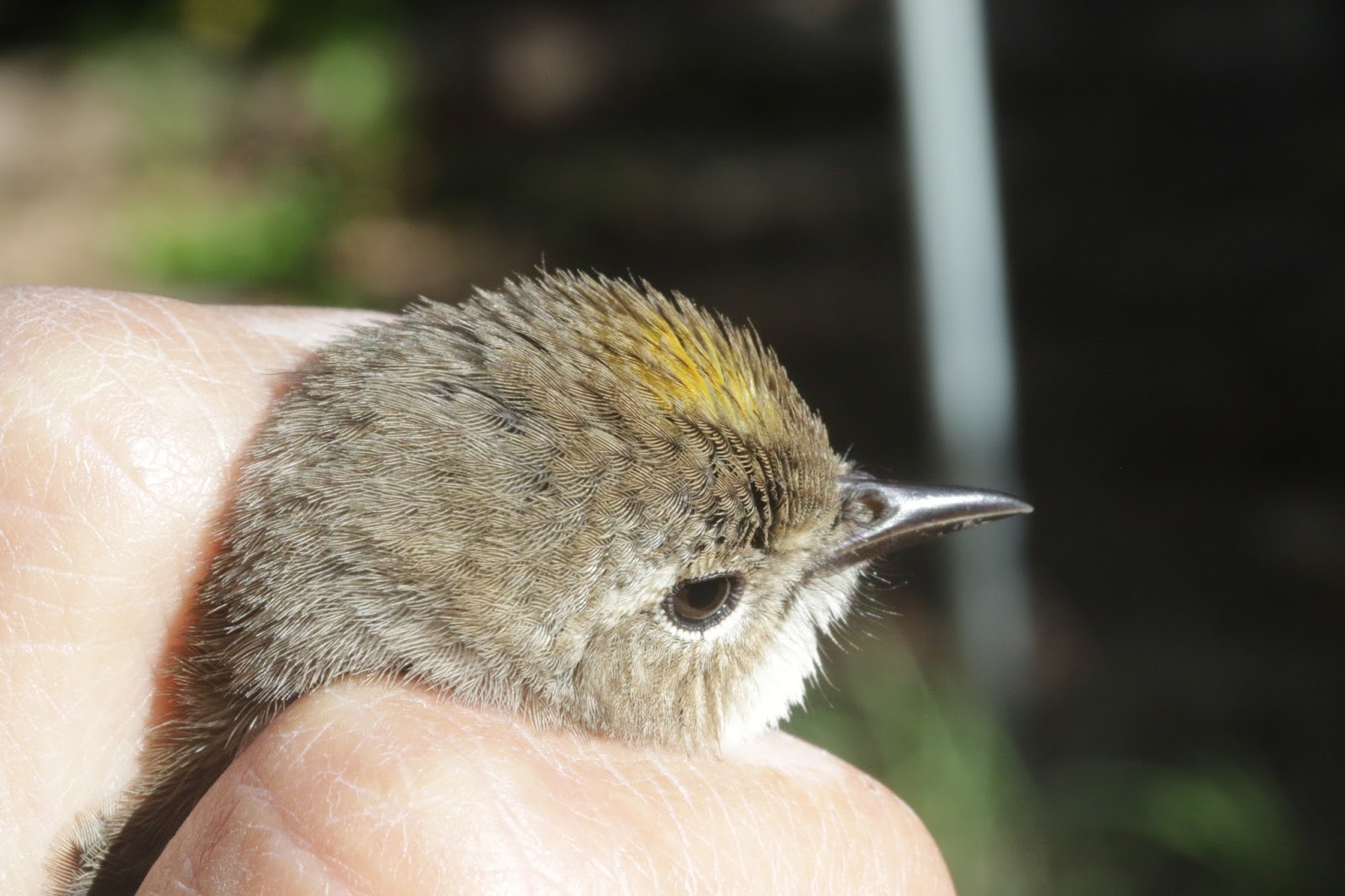
The Yellow-rumped Warbler is showing wear on its head that reveals the yellow that is seen in its breeding plumage.

Yellow-rumped Warbler
Photo by Bill LaFramboise

Our recaptures were 2 Painted Buntings that were banded this past fall.  Likely they remained in the vicinity of Possum Long.  We also recaptured a Blue Jay, a Gray Catbird, another Yellow-rumped Warbler, and an American Redstart.  The redstart was banded this past October and likely was not at Possum Long for the winter.  Nice to have it return.  We had identified it as a young male and that was further verified as it is developing more black on its face.  Recaptures give us a lot of information.  


American Redstart
Photo by Bill LaFramboise

We also saw more warblers moving through.  Numbers are much higher than what over-wintered.  These are the more southern breeding birds that go north early to claim their territories.  Those from farther north have to wait a bit more.  The species seen were Black-and White Warbler, Black-throated Blue Warbler, Northern Parula, and the recaptured redstart.  Hopefully the less common southern breeders show up next week.

The next session will be on MONDAY (March 19) instead of Tuesday.  This is a one-time change.  Nets go up at 6:45.


March 10, 2018

On March 10. we returned to PB 72.  This yard had a good combination of over-wintering birds and some returning migrants/summer residents!  It is encouraging!

We banded 4 Painted Buntings and recaptured one from last year. Several more were seen. 

Our first bird was an American Goldfinch; I think the only one so far this year.  We typically do not get this species at Possum Long so it is fun to band them at Painted Bunting sites.  This was a winter-plumaged male that was just beginning to turn more yellow.  The black (not greyish) wings indicate that it is male.  It will soon develop more black on the head as well as more yellow coloring.

American Goldfinch
Photo by Bill LaFramboise

We also banded 2 Gray Catbirds and a Red-bellied Woodpecker.

Red-bellied Woodpecker (female)
Photo by Bill LaFramboise

Flying over the property was a Purple Martin and a Swallow-tailed Hawk.  Always good to see!!

Catch-up post three.  Next session information on next post.


March 6, 2018

Another catching-up post here.  On Tuesday March 6, we banded at Possum Long.  We are starting to see a few more species that might be moving north to this location from over-wintering nearby or actually going on their way.  There really isn't any proof of which it is.  The catbirds that we caught earlier in the winter may have stayed at Possum Long or they may have gone farther south and came back through on their trip north.  Some of the Gray Catbirds are showing some fat accumulation which indicates they will be moving. 

It was a Gray Catbird day.  We banded two new ones and recaptured 4 more.

Gray Catbird
Photo by Bill LaFramboise

One of the recaptures was from March, 2014.  This means that this bird has flown up or down the east coast EIGHT times and returned to the same spot as 4 years ago!  Isn't migration fascinating.

As we wait for more species of migrants I especially appreciate the volunteers who come out week after week and are patient through sessions like this that seem slow.  They are the backbone of this project!

This is a catch-up post.  Next session details are on the March 13 entry.

March 5, 2018

My how time flies and I have four more updates to catch up on.  On March 5 we went to a new location,  our 75th!  I must say that all of our hosts have been so fun to meet.  This time was no different.  The habitat of this yard supported many buntings as well as so many butterflies.  It is good to meet kindhearted folks like here.

This location is within a half mile of another site as the bird flies but a bit farther by road.  There is a little water separating the two but it will be great to see if these two locations share birds!

We banded 12 Painted Buntings and had 7 incidentals.  A Northern Parula was first catch and was a treat as always.

Northern Parula
Photo by Bill LaFramboise

Painted Bunting (male)
Photo by Bill LaFramboise

Other incidentals included a Gray Catbird, a Northern Cardinal, 2 Blue Jays and 2 Common Grackles.

On our way home we went to Loxahatchee NWR to check on a Vermilion Flycatcher that has over wintered.  It was nice to see how much more red it has than it did in November.

Vermilion Flycatcher
Photo by Bill LaFramboise

This is a catch-up post.  Next Possum Long Banding will be listed on the March 13th entry.


Friday, March 2, 2018

February 27, 2018

We banded at Possum Long on Tuesday.  Numbers are picking up and we are starting to see and hear a few more birds.  It was very frustrating to hear but not see what might have been a Golden-winged Warbler singing!  The song is a very distinctive buzzy "bee-buzz-buzz".  There was still a Summer Tanager around.  We also had many delightful visitors who I hope continue to return to see migration progressing.

While we were setting up nets one visitor came early to photograph the Wood Duck in the nest box.  Well, it wasn't there but this was!!

Eastern Screech-Owl
Photo by Bill LaFramboise

Pretty early we recaptured an Ovenbird and banded our first Yellow-rumped Warbler.  Later we had 4 Yellow-rumps in the net at the same time.  We banded a total of 8!

Yellow-rumped Warbler
Photo by Bill LaFramboise

We also banded 3 Gray Catbirds and a Red-bellied Woodpecker.

Gray Catbird 
Photo by Bill LaFramboise

Red-bellied Woodpecker
Photo by Bill LaFramboise

the red belly of a Red-bellied Woodpecker
Photo by Bill LaFramboise

Another item of interest was this cute baby turtle.  Linda brought him over for all to see and then returned it to where it had been found.  Enjoy!


Next scheduled banding at Possum Long will be on March 6.  Nets go up at 6:45.  

NOTE:  There will be no banding at Possum Long on March 20.  However we will band on Monday, March 19 instead.


Sunday, February 25, 2018

February 23, 2018


I had some catch up to do so you might want to check the previous 3 posts that are also new.

On Friday we returned to PB 28, one of our more northern sites.  This is one of many favorite sites as the birds are plentiful, the garden is beautiful, and the hosts are wonderful.  We banded a whopping 20 Painted Buntings and recaptured 5 from previous years.  Also banded were 4 Indigo Buntings.  We had to take down a little early due to wind so who knows how many more there were???  Being kept busy with 26 birds banded and the recaptures, photos for this post are mostly about what we see when aging the birds.  


Painted Bunting (bird born last summer - SY)
Photo by Bill LaFramboise

In the above photo you might be able to see the unmarked feathers above the outer wing feathers (primaries).   The outer primary feathers have a more blackish rib and the inner ones (secondaries) are browner.  This tells us that this is a young, green bird born last summer.

Indigo Bunting (female)
Photo by Bill LaFramboise

You can see some feathers growing in on the above Indigo Bunting.  They mostly molt body feathers this time of year.  

Indigo Bunting
Photo by Bill LaFramboise

This is the wing of a young, male Indigo Bunting.  Much like the above wing of the Painted Bunting the feathers above the outer flight feathers do not have the blue edging of the other feathers in that row.  The gray-brown ones are feathers still retained from its first year.  This bird was born last summer but will develop more bright blue coloring soon.

One of the Painted Buntings had more young feathers than usual.  We cannot be sure why his first fall molt didn't fully occur.  Here is its tail.  Typically all of the feathers are changed.  You might be able to see that only one is fresher.

young, green Painted Bunting tail
Photo by Bill LaFramboise

We also banded a Gray Catbird and a Northern Cardinal.  

Next Possum Long session will be on Tuesday, February 27.  Nets go up at 6:45 am.

A very early warning - we will NOT be banding on Tuesday, March 20 but will on Monday, March 19.  (Weather permitting as always)

February 20, 2018

Tuesday, February 20 was a session at the Possum Long Banding Station.  It was a day of wonderful bird viewing.  There were more birds on and above the property but we only banded 5 birds.  This is an increase and we should continue to increase but the hard part is that nets are low and birds are high.

There were hundreds of Cedar Waxwings on the property and it felt like teasing!  So close yet so far.

Cedar Waxwings at Possum Long - just one of the trees
Photo by Robin Potvin

Cedar Waxwings at Possum Long
Photo by Robin Potvin

Also on the property was a Summer Tanager.  We have been spotting them for the last few weeks.  Not sure if they over-wintered again.  Both species were seen eating fruit from the Ficus (Fig) trees.  

Summer Tanager
Photo by Pete Grannis

However we did band 2 Northern Cardinals, 2 Gray Catbirds and a Yellow-rumped Warbler.  Among other recaptures we had a Common Yellowthroat that was banded in October.  

Yellow-rumped Warbler
Photo by Bill LaFramboise

Common Yellowthroat
Photo by Pat Marshall

Gray Catbird - I love revenge photos - bird biting bander
Photo by Bill LaFramboise

Congratulations to fellow birder Andrew Boyle and his volunteers.  They banded at the Orlando Wetlands Festival and had some great birds including a Philadelphia Vireo which was a surprise as they do not typically over-winter in Florida.  Read more a https://wekivaband.blogspot.com/    The 2/17/18 entry.

Next Possum Long session will be on Tuesday, February 27.  Nets go up at 6:45 am.

A very early warning - we will NOT be banding on March 20 but will on March 19.  (Weather permitting as always)