Tuesday, May 2, was our regular Possum Long banding session. As I stated in the last blog one hopes for certain weather in order to see and catch migrants here in Florida. That didn't happen on Tuesday so we banded just 2 Ovenbirds. As always, the group is terrific and we had fun watching and hoping.
Ovenbird
Photo by Roy Netherton
On the evening of May 4, there was a thunderstorm and prolonged rain. This tends to make birds stop migrating and to look for safe haven. Thursday morning I headed out to Possum Long even though my team, except Pete for 1/2 hour, wasn't available. I set up and then stopped for a while due to rain but from 11 am until Bill joined me after work I banded. I only ran 2 nets but we ended up with a total of 23 banded birds! There were American Redstarts everywhere. I estimated 50 on the property. We banded 15 American Redstarts, 1 Ovenbird, 3 Common Yellowthroats, 3 Black-throated Blue Warblers, and a Blue Jay.
I think this is one of the most unusual things I have found in a net. We have had dragonflies, cicadas, and more in the nets and back when I was training an American Kestrel dropped a mouse that it had caught but I never expected.......
....... a peanut. I had just banded the Blue Jay and went back to adjust the net and found what it had left behind. I guess it lost the snack for the day.
American Redstart (adult male)
American Redstart - young male with black face patches
Many of the redstarts were young birds, as is the young male above, and the young bird below. It looks like this bird may not have had adequate food in the nest. It will keep these flimsy feathers until the next molt in the fall. Otherwise the bird was very healthy with a good store of fat and a lot of energy. It had no trouble flying.
American Redstart with deformed tail
So, overnight the winds shifted to the NW. This is another factor in Florida that makes birds land during migration. It is on days like this that we can hope for a lot of birds.
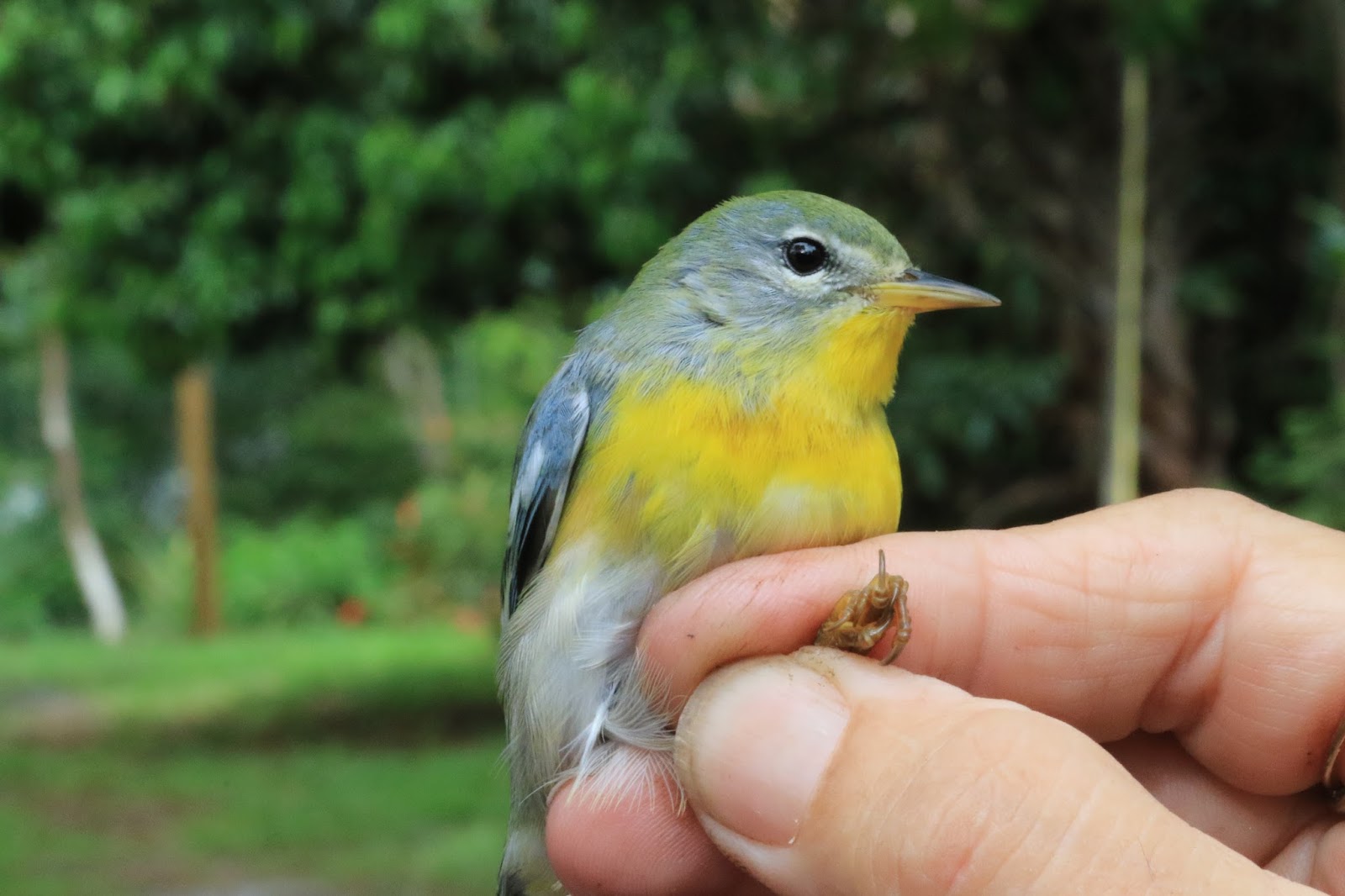
And boy did we get it!!! We set an all time record for banding at Possum Long. We banded 49 birds. The only higher day was during a Painted Bunting session when we banded 50 birds (3/21/14 - Season 1 Painted Buntings). Once again there were a lot of American Redstarts but also some new additions. We banded 28 American Redstarts, 1 Northern Parula, 4 Common Yellowthroats, 8 Black-throated Blue Warblers, 5 Ovenbirds, 1 Swainson's Thrush and 2 Red-bellied Woodpeckers.
Common Yellowthroat (young male)
Swainson's Thrush
Red-bellied Woodpecker
Ovenbird
Black-throated Blue Warbler
Appalachian race
Winds continued from the NW on May 7 so we opted for extra session number 3. Early on the crows were mobbing something. We have 3 types of raptors on the property with fledged young. We guessed one was near our nets. Then a thud. We found a young Osprey on the ground. It did not move away as we looked so we called Martin County Animal Control. An officer came out and at first assessed and observed the bird. It could move its wings so the next step was to get the bird out in the open. It finally flew off on its own.
juvenile Osprey
After the Osprey rescue we processed 25 birds. American Redstart numbers had dropped but throughout the day the Blackpoll Warbler numbers seemed to grow. We banded 10 American Redstarts, 4 Ovenbirds, 6 Black-throated Blue Warblers, a Common Yellowthroat and 4 other birds (suspense).
One was a Northern Waterthrush which we get only 1 or 2 a season so it was a welcome surprise.
Northern Waterthrush
Photo by Bill LaFramboise
Blackpoll Warblers (and Cape May Warblers) are so frustrating as they feed high in our tall trees. Other places where the trees are shorter they can sometimes be seen lower and would be more able to find their way into a net but not at Possum Long. Well, today was a first - the first Blackpoll Warblers banded at Possum Long. Two of them - both females.
Blackpoll Warbler - male (not banded)
Photo by Bill LaFramboise
Blackpoll Warbler - female - one of two banded
Photo by Bill LaFramboise
So, was that enough excitement for today? Nope, not even close. Today we also had another new bird for the property; one I had never seen in the county and had never banded before.
CONNECTICUT WARBLER!! This species travels through Florida very quickly and is hard to locate. Bill and I have seen this bird in several other states and a few times in Florida. Such a treat to see and evaluate in hand.
Connecticut Warbler
Photo by Bill LaFramboise
Winds are predicted to return to blowing in from the south. This is ideal weather for the migrants so we wish them well on their journey to breeding territories.
The next regularly scheduled banding at Possum Long will be Tuesday, May 9. Nets go up at 6:30. Winds may be back to blowing from the west!