Showing posts with label Swainson's Thrush. Show all posts

Thursday, October 19, 2017

October 16, 2017

On Monday we caught more bigger birds than warblers.  We did catch 1 American Redstart and TWO more Magnolia Warblers but the rest of the captures were big.  It has been hard to believe how many Magnolia Warblers are around and being captured.

We caught a good variety of the bigger birds:  Our second only Scarlet Tanager.  The white underwings are created by the flight feathers being half white and half black.  The black shows on the upper wing and the white shows on the underwing.  This is not the case with the similar Summer Tanagers.  This bird was missing its tail.  There were signs of it already growing back in. 

Scarlet Tanager

Scarlet Tanager

We also caught 3 thrushes:  2 Gray-cheeked and one Swainson's.  This Gray-cheeked does not show the spectacle that the Swainson's does.  It was carefully measured to rule out the smaller Bicknell's Thrush.

Gray-cheeked Thrush

We rarely capture Rose-breasted Grosbeaks but they had been on the property for several days and were feeding on figs, palm berries, and beautyberry fruit.  Last year when we caught another one it was feeding on beautyberry. 

Rose-breasted Grosbeak

The other birds caught and banded were 1 Brown Thrasher, 2 Gray Catbirds and 1 Northern Cardinal.

Note for next scheduled session is on the next post.


Sunday, October 8, 2017

October 7 & 8, 2017

Sometimes, especially during migration, we elect to band on days that are not at the regularly scheduled time.  We banded on both Saturday and Sunday this week and it was well worth it.  We are at the peak arrival for some of the birds.  Saturday was warbler day.  We banded 22 individuals representing 8 species of warblers.  The expected American Redstarts (3), Ovenbirds (2), and Black-throated Blue Warblers (9) did not disappoint.  We even caught one each of two less commonly caught warblers - Northern Parula and Black-and-white Warbler.  But then there were 3 highlights!!

American Redstart
Photo by Bill LaFramboise

Northern Parula
Photo by Bill LaFramboise

Highlight One was catching more than one Magnolia Warbler!  We have never caught three in one session before.

Magnolia Warbler
Photo by Laura Karg


Magnolia Warbler
Photo by Bill LaFramboise

Highlight Two was catching a first for Possum Long Banding.  Though Yellow-throated warblers are sometimes seen on the property, we had never banded one there.  

Yellow-throated Warbler

Highlight Three was catching not one but TWO Cape May Warblers.  In all of the other years we have banded we had only caught one of these.  Two on one day is pretty awesome.  Cape May Warblers are also typically too high in the trees to catch them.  In areas where there are not tall trees, these bird can be seen down low but they prefer the upper areas in the trees of Possum Long.

Two Cape May Warblers!!

So in addition to the 22 warblers on Saturday we also banded two Painted Buntings and a Red-eyed Vireo.  The vireo was an adult with a really red eye as opposed to the two younger birds we caught recently that had dark eyes.  

Red-eyed Vireo

On Sunday we caught half the number we did on Saturday and the bird diversity on the property was much different, yet it was still a productive session.  There were still Summer and Scarlet Tanagers around and several Red-eyed Vireos.  The surprise was seeing THREE Baltimore Orioles.  We did not catch those but once again, Black-throated Blue Warblers (4) were the majority of the birds caught.   

Black-throated Blue Warbler (female)
Photo by Bill LaFramboise

Other birds caught were 2 American Redstarts, a Black-and-white Warbler, a White-eyed Vireo, an Ovenbird, 2 Swainson's Thrushes, and a Gray Catbird.  Gray Catbird numbers should be increasing in the next few weeks.  

White-eyed Vireo
Photo by Bill LaFramboise

Black-and-white Warbler
Photo by Laura Karg

Swainson's Thrush
Photo by Bill LaFramboise

Gray Catbird
Photo by Bill LaFramboise

Thirty-seven birds in two days!

The next regularly scheduled session as announced on the previous post is on October 10, 2017.  Nets go up at 7:15 am.


Monday, October 2, 2017

September 30 and October 1, 2017

We did a little extra banding this weekend since it is migration time.  We banded at Possum Long on Saturday and at PB 46 on Sunday.  Saturday was productive but a bit slower than last Tuesday's session.  We banded 13 birds (8 species) and saw a few that went no where near the nets.  These were the first of season Cape May Warbler, several Scarlet Tanagers, a Northern Parula, and a Summer Tanager.

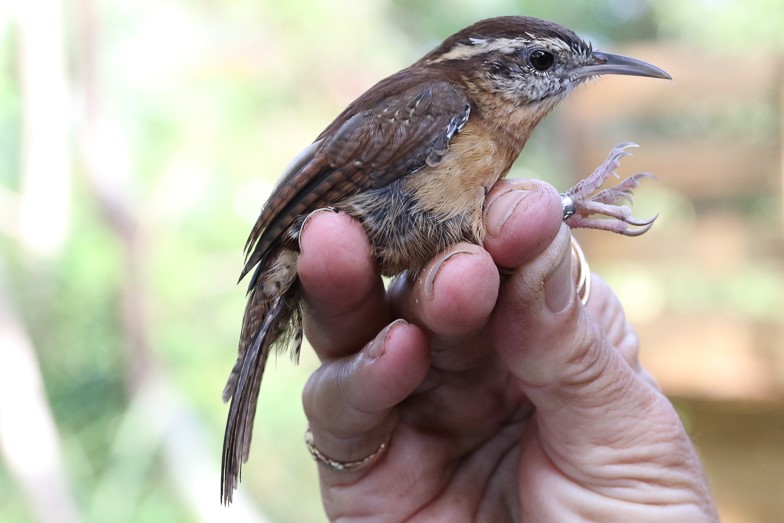
We banded 4 Black-throated Blue Warblers, 3 Ovenbirds, and one each of Red-eyed Vireo, Carolina Wren, Swainson's Thrush, Gray-cheeked Thrush, Northern Cardinal, and Gray Catbird.  Of these the thrushes made their first welcome appearance.  We should get more this month.  The Red-eyed Vireo was a young bird so it did not yet have a bright red eye.  It was the fifth one of this species for the property.  The Carolina Wren was only the second one on the property. 


Red-eyed Vireo

Carolina Wren
Photo by Bill LaFramboise

Gray-cheeked Thrush
Photo by Bill LaFramboise

Swainson's Thrush
Photo by Bill LaFramboise

At PB 46 we were pleased to catch some of their early Painted Buntings.  They estimated they had at least 10-15 birds back.  Three were previously banded.  We caught 5 new green Painteds.  we used our new split band - so be on the lookout for yellow/light green bands.

Painted Bunting with new split band color
Photo by Bill LaFramboise

One of the buntings was a very young bird.  Just out of the nest Painted Buntings, both male and female, are green and brownish.  They molt in the fall like the adults but ALL of the youngsters stay green.  They do not molt much until the next fall (about 15 months) and this is when the male birds acquire their pretty colors.  

Earlier in the season, these hosts had a 2nd year male bird starting to grow in the bright feathers.  We had received other photos just before Bob sent this one.  It is the first time we had photos of this particular change!!

Painted Bunting male acquiring its first bright feathers (approximatley 15 months old)
Photo by Bob Ellis


Back to the youngster, you can see in the photo below that it was heavily molting and that it still had some of the juvenal brownish feathers.  (Arrow)

Very young Painted Bunting with juvenal feathers
Photo by Bill LaFramboise

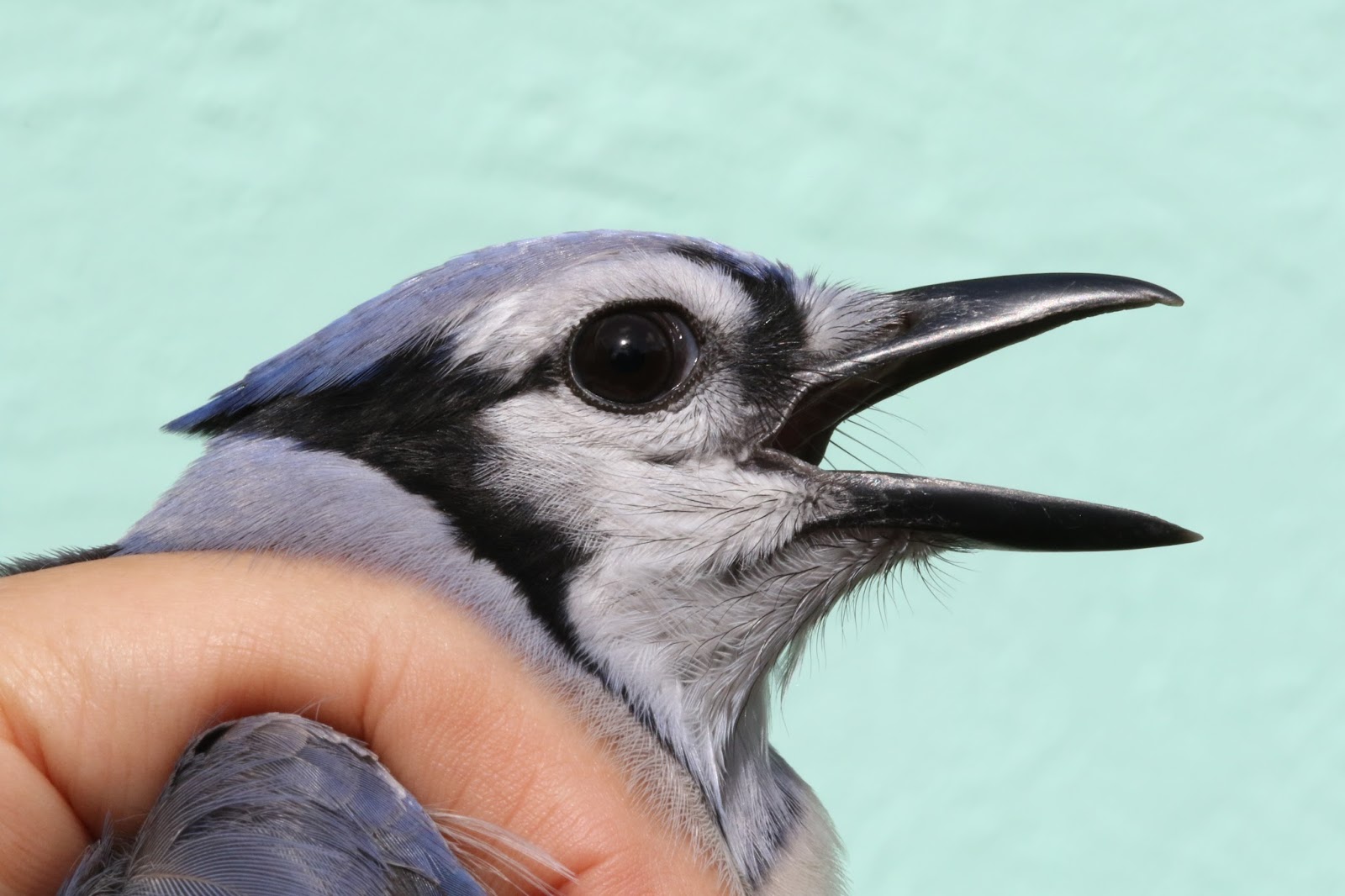
We also caught another Red-eyed Vireo as well as several Blue Jays, several Common Grackles, and a Northern Cardinal.  

Blue Jay
Photo by Bill LaFramboise

Common Grackle
Photo by Bill LaFramboise

We will band at Possum Long tomorrow, October 3.  Nets go up at 7 am.  It could be windy so hopefully the more sheltered nets won't blow.  If they do, we will close early.


Tuesday, May 9, 2017

May 9, 2017

Weather conditions once again turned favorable for birds to keep flying over us on their journey north.  There were still a few migrants around but numbers were much lower.  There were no longer 50 American Redstarts, more like 6-10.  Birds that were still present may have been resting or had stopped for more fuel.  In addition to the species banded we did see a few Blackpoll Warblers.

We banded 7 birds and said our good-byes to some more of our own helpers who will be heading north.  Linda and George brought refreshments and we wished Pete well on his journey to help at another banding station.

The seven birds newly banded were 3 American Redstarts, and one each of Swainson's Thrush, Common Yellowthroat, Black-throated Blue Warbler, and Ovenbird.

Refreshments

Swainson's Thrush

American Redstart (young male)


I will be checking the weather and the property to see what birds are around.  Likely we will do one more session on May 16.  If so, nets will go up at 6:30.  If not, I will change this announcement or post a new one.  Once summer and our break is underway, watch for a posting with results since our last update in December.

Sunday, May 7, 2017

May 2, 5, 6, and 7: Banders wait for days like this!

Tuesday, May 2, was our regular Possum Long banding session.  As I stated in the last blog one hopes for certain weather in order to see and catch migrants here in Florida.  That didn't happen on Tuesday so we banded just 2 Ovenbirds. As always, the group is terrific and we had fun watching and hoping.

Ovenbird
Photo by Roy Netherton

On the evening of May 4, there was a thunderstorm and prolonged rain.  This tends to make birds stop migrating and to look for safe haven.  Thursday morning I headed out to Possum Long even though my team, except Pete for 1/2 hour, wasn't available.  I set up and then stopped for a while due to rain but from 11 am until Bill joined me after work I banded.  I only ran 2 nets but we ended up with a total of 23 banded birds! There were American Redstarts everywhere.  I estimated 50 on the property. We banded 15 American Redstarts, 1 Ovenbird, 3 Common Yellowthroats, 3 Black-throated Blue Warblers, and a Blue Jay.

I think this is one of the most unusual things I have found in a net.  We have had dragonflies, cicadas, and more in the nets and back when I was training an American Kestrel dropped a mouse that it had caught but I never expected.......


....... a peanut.  I had just banded the Blue Jay and went back to adjust the net and found what it had left behind.  I guess it lost the snack for the day.

American Redstart (adult male)

American Redstart - young male with black face patches

Many of the redstarts were young birds, as is the young male above, and the young bird below.  It looks like this bird may not have had adequate food in the nest.  It will keep these flimsy feathers until the next molt in the fall.  Otherwise the bird was very healthy with a good store of fat and a lot of energy.  It had no trouble flying.

American Redstart with deformed tail

So, overnight the winds shifted to the NW.  This is another factor in Florida that makes birds land during migration.  It is on days like this that we can hope for a lot of birds.

And boy did we get it!!!  We set an all time record for banding at Possum Long.  We banded 49 birds. The only higher day was during a Painted Bunting session when we banded 50 birds (3/21/14 - Season 1 Painted Buntings).   Once again there were a lot of American Redstarts but also some new additions.  We banded 28 American Redstarts, 1 Northern Parula, 4 Common Yellowthroats, 8 Black-throated Blue Warblers, 5 Ovenbirds, 1 Swainson's Thrush and 2 Red-bellied Woodpeckers.

Common Yellowthroat (young male)

Swainson's Thrush

Red-bellied Woodpecker

Ovenbird

Black-throated Blue Warbler
Appalachian race

Winds continued from the NW on May 7 so we opted for extra session number 3.  Early on the crows were mobbing something.  We have 3 types of raptors on the property with fledged young.  We guessed one was near our nets.  Then a thud.  We found a young Osprey on the ground.  It did not move away as we looked so we called Martin County Animal Control.  An officer came out and at first assessed and observed the bird.  It could move its wings so the next step was to get the bird out in the open.  It finally flew off on its own.  

juvenile Osprey

After the Osprey rescue we processed 25 birds.  American Redstart numbers had dropped but throughout the day the Blackpoll Warbler numbers seemed to grow.  We banded 10 American Redstarts, 4 Ovenbirds, 6 Black-throated Blue Warblers, a Common Yellowthroat and 4 other birds (suspense).  

One was a Northern Waterthrush which we get only 1 or 2 a season so it was a welcome surprise.

Northern Waterthrush
Photo by Bill LaFramboise

Blackpoll Warblers (and Cape May Warblers) are so frustrating as they feed high in our tall trees. Other places where the trees are shorter they can sometimes be seen lower and would be more able to find their way into a net but not at Possum Long.  Well, today was a first - the first Blackpoll Warblers banded at Possum Long. Two of them - both females.  

Blackpoll Warbler - male  (not banded)
Photo by Bill LaFramboise


Blackpoll Warbler - female - one of two banded
Photo by Bill LaFramboise

So, was that enough excitement for today?  Nope, not even close.  Today we also had another new bird for the property; one I had never seen in the county and had never banded before.

CONNECTICUT WARBLER!!  This species travels through Florida very quickly and is hard to locate.  Bill and I have seen this bird in several other states and a few times in Florida.  Such a treat to see and evaluate in hand.

Connecticut Warbler
Photo by Bill LaFramboise

Winds are predicted to return to blowing in from the south.  This is ideal weather for the migrants so we wish them well on their journey to breeding territories.  

The next regularly scheduled banding at Possum Long will be Tuesday, May 9.  Nets go up at 6:30. Winds may be back to blowing from the west!


Monday, May 1, 2017

April 25, 2017 and a few more

April 25 will likely go down in the record books for numbers of birds.  Winds favorable for seeing migrants finally arrived and I was out of town!  Permit holder Pete Grannis with support from Jim and Roy banded a total of 24 birds:  12 Black-throated Blue Warblers, 3 Ovenbirds, 2 Gray-cheeked Thrushes, an Indigo Bunting, a Common Yellowthroat, a Veery, a Swainson's Thrush, a Gray Catbird, an American Redstart, and a Black-and-white Warbler.  My thanks to this crew who made it possible to not miss this wave of birds.  There might be more western winds later this week and we will be out there Tuesday or not!

Indigo Bunting
Photo by Pete Grannis

Black-throated Blue Warbler
Photo by Pete Grannis

Ovenbird
Photo by Pete Grannis

Black-and-white Warbler
Photo by Roy Netherton

Gray-cheeked Thrush
Photo by Roy Netherton

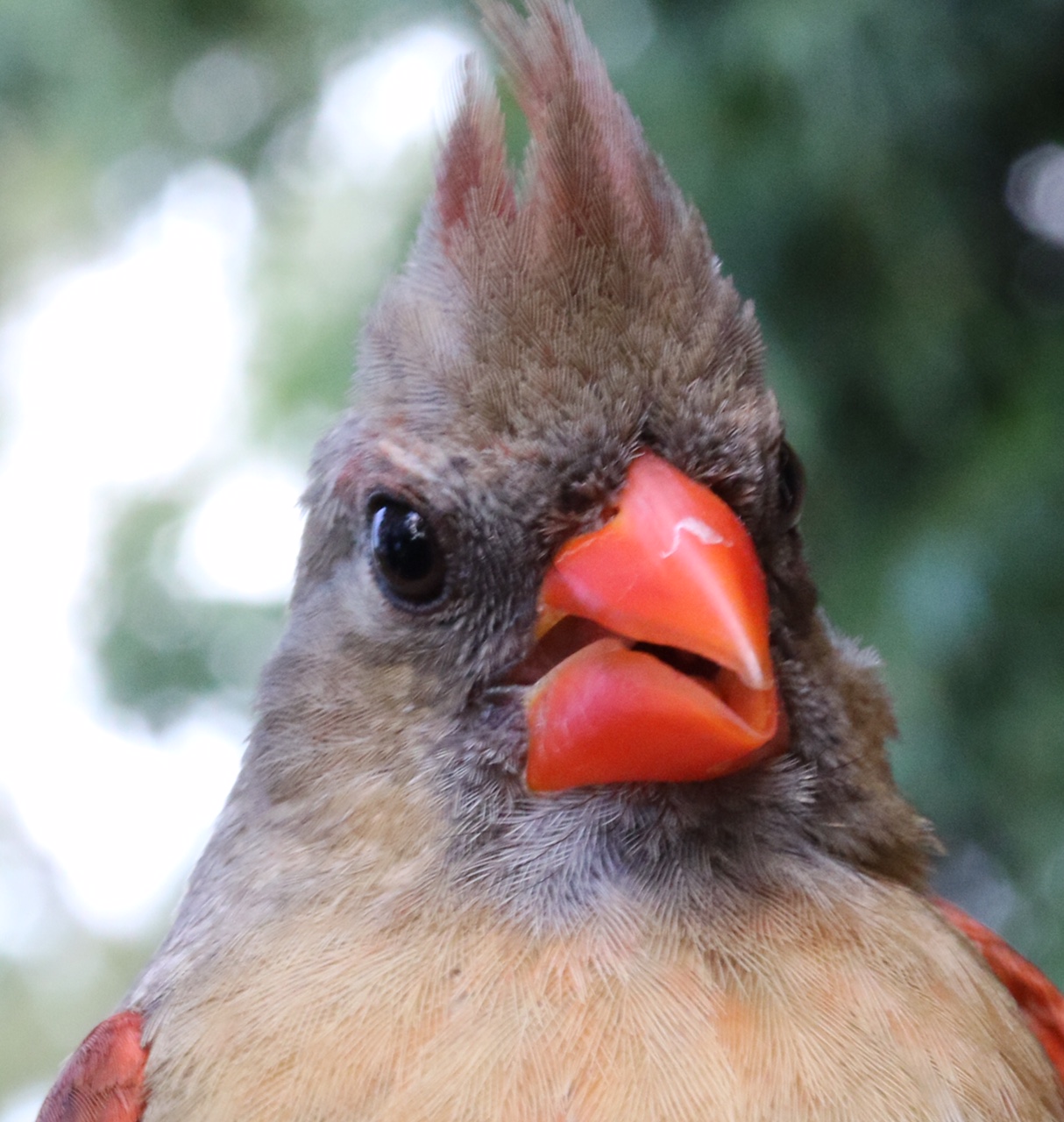
Our other permit holder, Bill LaFramboise, ran two sessions (April 22 and April 28) even though winds were not as favorable.  Several Northern Cardinals were banded as was a Gray Catbird and our final Painted Bunting.

Gray Catbird
Photo by Bill LaFramboise

Painted Bunting (SY)
Photo by Bill LaFramboise

Northern Cardinal
Photo by Bill LaFramboise

So, there should be a few more sessions at Possum Long and then we will break for the summer and see you all again sometime in August.  A future post will let you know when.

Next Possum Long Session will be on Tuesday, May 2.  Nets open at 6:45.  Remember pouring rain will delay or cancel a session.