Monday, November 9, 2015

November 3, 2015

At first blush this day looks a little dismal with only 3 new Gray Catbirds banded.  Most of the story is with the 4 recaptured birds we caught.

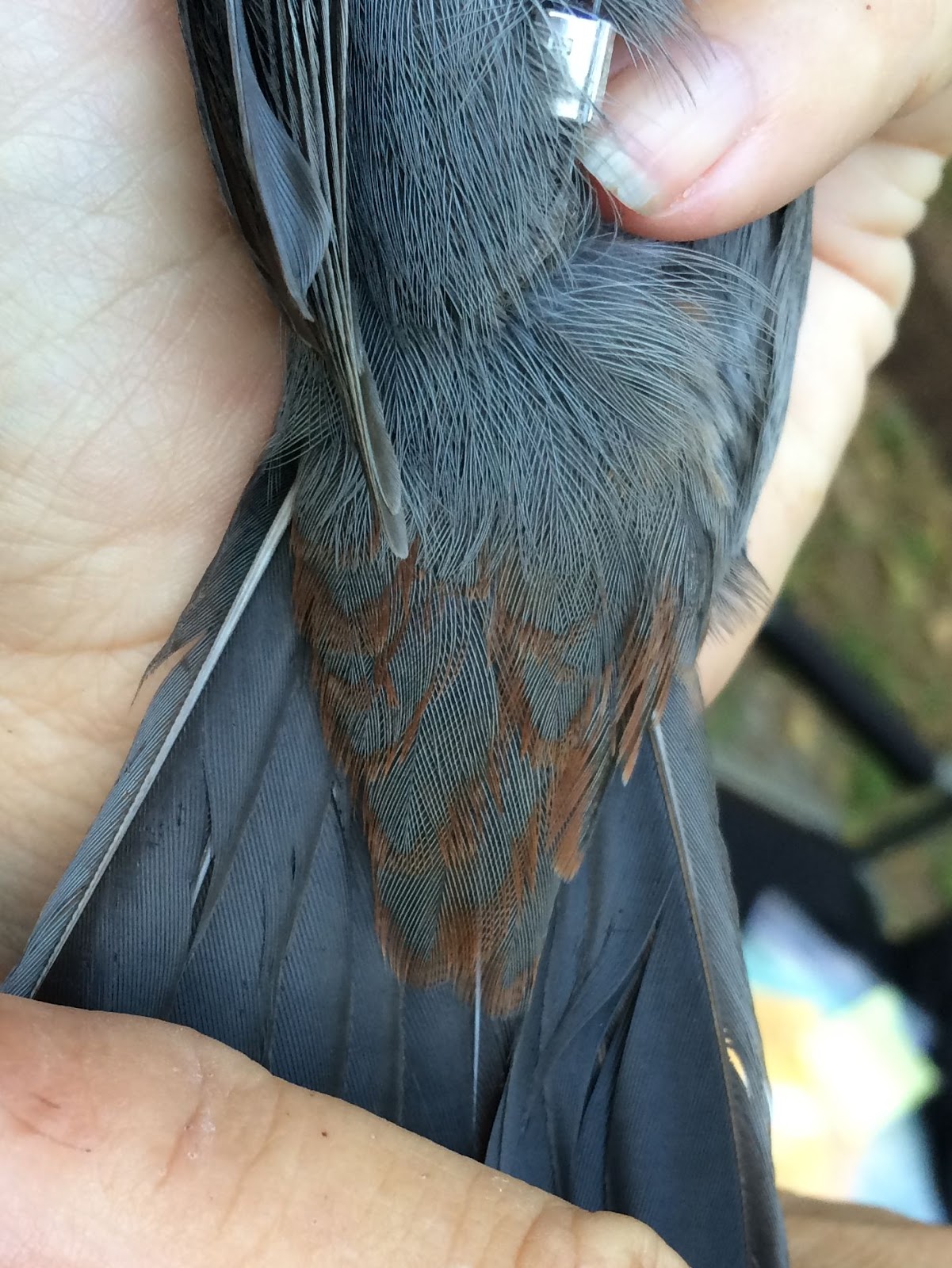
Since our road trip to the Yellow Rail and Rice Festival with its banding workshop (see post), we are looking at wings differently.  Young Gray Catbirds do show a molt limit (a way we age birds) and our wing photo shows that this is an adult bird (no molt limit).  There is silver edging to the small feathers just above the outer flight feathers.

Gray Catbird
Photo by Jane Wiewora

We recaptured a Gray Catbird, a Common Yellowthroat, a Northern Cardinal and the Gray-cheeked/Bicknell's Thrush.  We were able to measure one other aspect of this bird and will be submitting it to various people to see if we may still be able to determine which one we had.  Some characteristics are in the overlap zone including the new measurement we made.  However most of the other measurements were only in the Bicknell's range.  Identity still to be determined.

The photos of two of the recaptures:

Common Yellowthroat
Photo by Jane Wiewora

Gray-cheeked/Bicknell's Thrush
Photo by Jane Wiewora

Next regularly scheduled banding:  November 10.  Nets go up at 6 am.

October 28 to November 2: Road Trip Number Two

Four of the banding team (myself, Nancy Price, Jane Wiewora, and Bill LaFramboise) decided to take a workshop to improve our banding skills.  We attended one at the Yellow Rail and Rice Festival in Jennings, Louisiana.  We drove and birded our way there and attended class on Thursday evening.  A lot of new information is being developed on aging birds and we learned a lot.  We will be looking at wing molt a lot differently now.

Friday morning we banded at a woodlot.  There were new birds both caught and observed there.  It was fun to hear Greater White-fronted Geese fly over.  A sound we do not get in Florida.  I'm not sure of the entire species list banded but some of the birds were: White-throated Sparrow, Song Sparrow, Eastern Phoebe, Ruby-crowned Kinglet (I banded it, new for me!), Northern Cardinal, Swamp Sparrow, and Brown Thrasher.  A Northern Mockingbird from a previous festival was recaptured.

White-throated Sparrows (comparing two birds)
Photo by Jane Wiewora

Ruby-crowned Kinglet (#103)
Photos by Jane Wiewora

The bird was female so no "ruby crown" to show.  After I banded the kinglet, our instructor showed us some details in the wing and then set it directly on the scale to be weighed.  Be assured the bird is fine.  Birds don't know what to do when they are on their backs - an unusual position for them.  It flew off just fine and yes, the weight was obtained.  

Ruby-crowned Kinglet
Photos by Jane Wiewora

We next went to the rice fields to see rice being harvested.  As the combine works the fields, birds are flushed and nets catch some of the birds.  Migrant rails use these fields to feed.  We did not catch any Yellow Rails as Louisiana had so much recent rain the field we went to was too wet.  They prefer drier fields.  (They were seen by festival participants the day before and 2 were seen in this field.)

Rice combine harvesting

Rice being off loaded to truck

Close up of cut and not cut rows of rice
Photos by Nancy LaFramboise

We did however band 47!! Sora, 2 Virginia Rails, several Savannah and Swamp Sparrows.  The Sora and Virginia Rails were my #104 and #105 birds banded.

Sora (not the one I banded)
Photo by Nancy LaFramboise

Sora - note holding the legs differently - don't want to get impaled by those toes!
Photo by Bill LaFramboise

Virginia Rail  (not the one I banded)
Photo by Nancy LaFramboise

Unfortunately rain impeded much more banding.  We birded Lacassine NWR and enjoyed a few birds we rarely get to see such as Neotropic Cormorant, Vermilion Flycatcher, and White-faced Ibis.

Homeward bound we had rain from Louisiana to past Pensacola.  Nonetheless it was a great experience.  I would recommend it to anyone!


Tuesday, October 27, 2015

October 27, 2015 Bunting Busy

This will be short & sweet but I will add more later.

The caged feeders for the Painted Bunitngs appear to be working.  We banded 4 green (can't tell female or first-year male) Painted Buntings today.  Some were still loaded with fat and may move on and others were empty.  It will be interesting to have observations to see how long each individual stays.

We also banded another Gray-cheeked/Bicknell's Thrush.  This one had more data that supports Bicknell's but the wing chord was in the overlap range.  We will have to get more information so for now it is one of the two in the overlap range.

We also banded/recaptured 2 Black-throated Blue Warblers, 2 Ovenbirds, 1 Gray Catbird, and 1 Common Yellowthroat.


Above three photos are of a undetermined Gray-cheeked/Bicknell's Thrush
Photos 1 and 2 by Bob Ellis; Photo 3 by Jane Wiewora

Painted Bunting
Photo by Bob Ellis

Next banding:  Tuesday, November 3.  Nets open at 6 am - remember time change!

Tuesday, October 20, 2015

October 20, 2015 Indecision

There is the agony of indecision.  Yesterday was very windy and the forecast was for more high winds.  Could we band??  It seemed to calm down overnight but it is not good to band in the wind as nets can be seen, birds can be injured, and tree limbs or debris may fall on the team.  So I sent out texts and emails stating we would likely not band but I would go see what conditions were like at sunrise.  Should I cancel?  Who would show up?  Well, Jane has the longest drive and she showed up and in the cover of the trees it was not too windy.  We waited for sunrise to see if we heard birds.  We did.  We set up 5 nets.  First run:  6 Gray Catbirds!  It did not stop after that.  Didn't have time to even call folks to tell them what we up to!  George arrived and he is as always gracious enough to stand guard over our gear while we check nets. It was very good to see Marko and Roy who came to visit; I thank both of them and Jane for taking photos. (Roy's will be on the Painted Buntings - Season 3 page)

By noon we had banded 15 Gray Catbirds, 1 Swainson's Thrush, 1 American Redstart, 1 Ovenbird and we ended the session with a green Painted Bunting. We also recaptured an Ovenbird that was originally banded this September and a Gray Catbird originally banded as an adult bird in April, 2013.  We had recaptured this bird on December 9, 2014 so it has now been on the property during 3 different years.

Not bad for a day that we were "likely not banding".  Photos follow.........

Gray Catbird - one of 15!
Photo by Jane Wiewora

American Redstart
Photo by Jane Wiewora

Recaptured Gray Catbird 
(looks like the rest of them except its band is no longer shiny)
Photo by Jane Wiewora 

Gray Catbird - with unusually gray undertail coverts
Photo by Marco Sillanpaa


Swainson's Thrush
Photo by Jane Wiewora

Next banding:  Tuesday, October 27.  Nets go up at 7 am.


Thursday, October 15, 2015

October 13, 2015

Today was a pretty normal fall banding day.  We had captures of expected birds and a nice returning treat.  We banded 5 Gray Catbirds, 2 Black-throated Blue Warblers, a Northern Cardinal and a Common Yellowthroat.  There were other migrants around (redstarts, Yellow-throated Warbler, gnatcatchers) as well as year-round residents.  A flyover and likely migrating raptor was exciting - as it is always a treat to see a Peregrine Falcon.

One of the five Gray Catbirds had an unusual white mark on its wing.  Two of the covert feathers were white.  Partial albinism is not rare in birds and is always fun to discover even in small amounts.

Gray Catbird
Photo by Jane Wiewora

The male Black-throated Blue Warbler was very well marked with a wide white wing spot and all indications were that he was an adult bird (not born this summer).  We also banded a female of this species.

Black-throated Blue Warbler
Photo by Jane Wiewora

The Common Yellowthroat was a young, male bird.  Its black mask was just about outlined on its face.

Common Yellowthroat (young male)
Photo by Jane Wiewora

Our excitement was a returned Painted Bunting that we color banded on February 17th.  At the time this bird was all green.  It likely flew north for the summer.  Now, upon its return it had the brightly colored feathers to show that it is male.  Unfortunately the bird was likely a tad stressed from its migration so we released it without getting photos.  I'm sure everyone will agree that the bird's safety comes first.

Next banding:  Tuesday, October 20.  Nets go up at 6:30 am.  


Thursday, October 8, 2015

October 4, 5, & 6

I was very much hoping that a change in the weather would bring the migrants that most Florida birders are waiting for.  They seem to be held up in the north.  All three days were very quiet and likely we missed the rush by just a few days.

Sunday morning we banded at thrush that had the appearance of a Gray-cheeked Thrush.  Gray-cheeked Thrushes are virtually identical to Bicknell's Thrushes.  To tell them apart there are various measurements that have to be taken.  Bicknell's are the smaller of the two species (and this one seemed small) but there is some overlap in size.   As it turns out, the measurements were in the overlap range of these two species so we still cannot tell which species it is.  It was recorded as a GCBT; a banding code for birds in the overlap zone.

Gray-cheeked/Bicknell's Thrush
Photo by Nancy Price

Gray-cheeked/Bicknell's Thrush - studying the wing and taking measurements
Photo by Nancy Price

We managed to catch a few birds over the three days but most migrants that were around were quite high in the trees.  We are hoping to get a canopy net to use by next spring.

We banded the thrush, a Red-bellied Woodpecker (hatch-year male), 2 Gray Catbirds, and had 2 recaptured Ovenbirds and a recaptured Northern Cardinal.


Gray Catbird
Photo by Nancy LaFramboise

Northern Cardinal - recapture
Photo by Jane Wiewora

One exciting addition to the Possum Long property was a flyover Northern Harrier.  It is now the peak of raptor migration so it was great to see a new bird for the property.

Next regularly scheduled banding:  Tuesday, October 13.  Nets go up at 6:30 am.

Friday, October 2, 2015

September 30-October 2, 2015 ROAD TRIP!!

Nancy Price, Jane Wiewora, and I took a trip to visit the Jekyll Island Banding Station (JIBS) in Georgia. Jekyll Island is about 5 hours north of us.  We wanted an opportunity to do two things:  see, evaluate, and band species we have yet to experience and to network with another banding team. JIBS has operated for the past 38 years.  They band every day for about a month from late September into October.  They are monitoring fall migration in a coastal scrub environment.

Nets at Jekyll Island Banding Station


We had a wonderful visit to this station and appreciate the folks who made us so welcome.  JIBS is an all volunteer effort under the direction of bander Evan Pitman.  We are thankful that he was willing to share with us and to let us band two exciting birds.  More information on JIBS can be obtained from Evan at westernpalm@gmail.com  or on their Facebook page https://www.facebook.com/JIBS-Jekyll-Island-Banding-Station-145147734084/timeline/ 
Donations can be made at this page or by contacting Evan.

Thursday morning was fairly hot and humid.  The station banded 49 birds (9 species) and all of them were familiar to us.  We assisted with extracting the birds from the nets, data recording, and observed station procedures.
Jekyll Island--South Beach, Glynn, Georgia, US
Oct 1, 2015 7:00 AM to noon
9 species
White-eyed Vireo 2 Banded
Red-eyed Vireo 1
Gray Catbird 2
Common Yellowthroat 19
American Redstart 1
Palm Warbler (Western) 14
Prairie Warbler 2Northern Cardinal 7
Painted Bunting 2

We were very pleased to be able to observe a hatch year Painted Bunting as the young birds (male and female) that we get have undergone their first fall molt which makes them the same as older female (green) birds.  This bird was starting its fall molt but still had young browner/grayer juvenile feathers, was molting body feathers, and had yet to grow in its replacement tail.  

Painted Bunting
Photo by Nancy LaFramboise

Thursday evening there was a change of weather with a hard rain.  Friday was cooler, drier, and overcast.  Species diversity increased and the station caught a total of 87 birds.  Two of them were birds we had not had at Possum Long.  Evan was very generous and allowed me to study and band these two.  I will always remember JIBS as the place where I was able to reach a milestone in my banding experience.

Jekyll Island Banding Station  Jekyll Island--South Beach, Glynn, Georgia, US
Oct 2, 2015 7:00 AM - 3:00 PM

18 species (2 subspecies of Palm Warbler)
Yellow-billed Cuckoo 1 banded
Downy Woodpecker 2 banded
White-eyed Vireo 3 1 banded 2 recap
Red-eyed Vireo 1 banded
House Wren 1 escaped
Carolina Wren 2 banded
Gray Catbird 8
Northern Mockingbird 4 3banded 1 recap
Black-and-white Warbler 1 banded
Common Yellowthroat 44 banded
American Redstart 1 banded
Cape May Warbler 2 banded
Black-throated Blue Warbler 2 banded
Palm Warbler (Western) 7 banded
Palm Warbler (Yellow) 1 banded
Prairie Warbler 1
Northern Cardinal 5 4banded 1 recap
Painted Bunting 4 banded
Baltimore Oriole 1 banded

First bird new bird for me was a Yellow-billed Cuckoo.  My 100th species banded.

Yellow-billed Cuckoo
Photo by Jane Wiewora


The second bird was a Baltimore Oriole.  

Baltimore Oriole
Photo by Nancy Price

Baltimore Oriole
Photo by Nancy LaFramboise

We are continuing our study at the Possum Long Banding Station as well as the color banding of Painted Buntings (see pages).  We are also open to more experiences with new birds and locations. I'd like to experience other small birds that we have yet to encounter.  I will be looking for opportunities to explore other birds groups such as shorebirds or possibly gulls or terns.  Who knows?  Keep reading and we will share it all.

Hopefully I can add some more photos soon when we process more images.  Come back soon!