Today was once again very slow. We waited almost 4 hours with 7 nets up and we only caught one bird. Yes, you guessed it - Gray Catbird.
No photographs either.
I am considering a break for a week or two and hopefully things will move soon. Keep a watch here (I'll amend the end of this post) for the latest on the next banding. Likely this will happen on February 11, 2014. Nets up at 6:30. Maybe February 4 if the water level in the pond is lower.
Tuesday, January 21, 2014

Tuesday, January 14, 2014
January 14, 2014
Well, today can only be described as quiet. It is obvious that some more winter birds have moved in but unfortunately they are flyovers or high in the trees. American Robins are around as are American Goldfinches. From contact with people who feed Painted Buntings (see new page with information on this project), they were late this year but numbers seem to be increasing. So, the winter doldrums have hit. The good news is that last year we had more captures starting in February!
Today we had one recapture of a Gray Catbird originally banded in December.

Gray Catbird
Photo by Bill Eaton
We were also visited by a species that does not typically frequent the property. A young Little Blue Heron patrolled the pond. The pond was very high with water over the new walkway bridge and covering all of the berms where we have been placing nets.


Little Blue Heron
Photos by Nancy LaFramboise
Next banding session: January 21, 2014 - nets go up at 6:30 am
Thursday, January 9, 2014
January 9, 2014 TODAY'S BANDING CANCELED
Banding is canceled today because of the rain. Hope to see everyone at the next session which will be on our regularly scheduled Tuesday.
In the meantime, check out the page I've created about our new endeavor - color banding Painted Buntings. We have been to 5 locations already and have banded 23 so far. Incidental captures have been fun too. I have added two new species to my banded list.
Next banding session: Tuesday, January 14. Nets go up at 6:30 am, weather permitting.
In the meantime, check out the page I've created about our new endeavor - color banding Painted Buntings. We have been to 5 locations already and have banded 23 so far. Incidental captures have been fun too. I have added two new species to my banded list.
Next banding session: Tuesday, January 14. Nets go up at 6:30 am, weather permitting.
Tuesday, December 31, 2013
December 31, 2013
So ends 2013 and what a year it has been. In 2013 we saw a total of 97 species on the property (see entire list in the pages) Since July 2011 I have only seen 6 additional species there for a total of 103 species on the property.
In 2013 we banded a total of 270 birds that represented 39 species. In our short beginning in 2012 we only had 13 birds but 2 of those birds were species we did not catch this year.
We held 50 sessions that had newly banded birds.
Today was not a day when we added new species to the property or even any newly banded birds but it was one of my favorite sessions so far. We had an visit with Cub Scout Pack 814 and two additional Boy Scouts from Troop 811 in which we explored science in action. These young men were very interested and we talked a lot about banding. They asked very good questions too.


In 2013 we banded a total of 270 birds that represented 39 species. In our short beginning in 2012 we only had 13 birds but 2 of those birds were species we did not catch this year.
We held 50 sessions that had newly banded birds.
Today was not a day when we added new species to the property or even any newly banded birds but it was one of my favorite sessions so far. We had an visit with Cub Scout Pack 814 and two additional Boy Scouts from Troop 811 in which we explored science in action. These young men were very interested and we talked a lot about banding. They asked very good questions too.
We did have three recaptures: a female Northern Cardinal, a Yellow-rumped Warbler, and a Gray Catbird. The Yellow-rumped Warbler had been banded in February which means it had since left to migrate north and then had made the return migration south and arrived back at Possum Long. I have seen such returns (site fidelity) with birds at feeders but I find it hard to imagine this bird finding its way back to Possum Long without having a food source as reliable as a feeder to attract it.
One scout was able to hold a bird today. I didn't feel right subjecting someone to the bite of a cardinal - that's not pleasant at all. The Yellow-rumped Warbler fit in his hand and he did a marvelous job releasing the bird. I look forward to the troop returning during spring break when more birds should be present.
Photo by Leanne LaFramboise
The Gray Catbird was banded two weeks ago and at the time we were not able to get a clear picture of the growth bars its feathers showed. Luckily we got a second chance. This bird was born this past summer and either due to mites (you can see holes in the feathers at the bottom left) or a poor food supply, the feathers grew in alternating thin and thick (and appearing darker and lighter) in places giving it a striped look. Somewhere between the time we caught it and now, it had lost the left side of its tail but there was evidence of it growing back in.
Gray Catbird
As of tomorrow all birds will be a year older - Happy New Year readers and Happy Birthday to the birds!
Next banding session will be on THURSDAY (not the regular Tuesday) January 9. Nets go up at 6:30.
Tuesday, December 17, 2013
December 17, 2013
Well, good thing we attempted to keep banding in December as this one is so much different than last year. Part of the solution is having more nets. We also concentrated on the pond area today as that's where most of the bird activity has been. Also, having ready, willing, and able volunteers makes a difference.
Today at first we had recapture birds. Northern Cardinal and Gray Catbird. Another unbanded Northern Cardinal was released because its legs were too thick for the proper band. We saw this last year and were told the thickening is due to bird mites.


Then we got new birds; a total of eight. Four were Yellow-rumped Warblers and they just may be the "birds of the winter". There's a lot to learn about aging these birds. The upper tail coverts help as well as some of the body markings. The blue edges to the coverts and the bluish coloring of the back of this one indicates an adult non-breeding male as does the traces of black coming in on the face mask.


Today at first we had recapture birds. Northern Cardinal and Gray Catbird. Another unbanded Northern Cardinal was released because its legs were too thick for the proper band. We saw this last year and were told the thickening is due to bird mites.
Northern Cardinal with thickened legs
Photo by Bill Eaton
Northern Cardinal recapture with molting body feathers
Photo by Bill Eaton
Then we got new birds; a total of eight. Four were Yellow-rumped Warblers and they just may be the "birds of the winter". There's a lot to learn about aging these birds. The upper tail coverts help as well as some of the body markings. The blue edges to the coverts and the bluish coloring of the back of this one indicates an adult non-breeding male as does the traces of black coming in on the face mask.
Yellow-rumped Warbler
Photo by Crystal Conway
Yellow-rumped Warbler
Photo by Bill Eaton
Yellow-rumped Warbler
Photo by Bill Eaton
We also got two Gray Catbirds and a Blue-gray Gnatcatcher. We hadn't had a gnatcatcher in a while. It always amazes us how really small this bird is. It weighed 4 grams (1/7 of an ounce!).
Blue-gray Gnatcatcher into the bag to be weighed
Photos by Bill Eaton
Also exciting was capturing another Painted Bunting. This was also a "green" like the recapture of last week - not able to determine age or sex of these. Could be female or a young male.
Painted Bunting
Photo by Bill Eaton
We are now working with Dr James Rotenberg at the University of North Carolina Wilmington and Florida Wildlife Commission to color band Painted Buntings on their wintering grounds here in Florida. So, this "green" was the first to be color banded at Possum Long. A lot of this banding will occur at feeders and we have already banded 13 at Nancy Price's feeders. More information can be found at the Painted Bunting Observer Team (PBOT)'s web page at http://www.paintedbuntings.org/ Even though we are just getting started we have made it to the blog on that site. Most of the Painted Bunting banding except those captured at Possum Long will not be written up here. We will let you know how this information gets posted.
Painted Bunting
Photo by Bill Eaton
Next scheduled banding: December 31, 2013 - expecting Boy Scout Troop to visit. Nets go up at 6:30 am.
First 2014 banding will be on THURSDAY, January 9.
Tuesday, December 10, 2013
December 10, 2013
I must say that I have a very enthusiastic banding crew and I appreciate them all. Since the net across the pond was so productive and since we had yet to capture the House Wren and Eastern Phoebe, we placed two nets across the pond and 5 elsewhere on the property.
First we got a Yellow-rumped Warbler. You can see the obvious yellow rump and also the less obvious faint eye line indicating the eastern "Myrtle" subspecies .


First we got a Yellow-rumped Warbler. You can see the obvious yellow rump and also the less obvious faint eye line indicating the eastern "Myrtle" subspecies .
Yellow-rumped Warbler
Photo by Bill Eaton
Then Nancy Price brought the long-awaited Eastern Phoebe to the banding table. We examined this flycatcher up close noting the bristles around its beak and the lovely yellow color of the interior of its mouth. The legs were small in proportion to this larger bird's body. The aerial life does not require strong legs.
Eastern Phoebe
Photo by Bill Eaton
Eastern Phoebe
Photo by Bill Eaton
Next on the agenda was the House Wren. It was fun to reacquaint myself with a bird we frequently caught at the MAPS station where I used to band.
House Wren
Photo by Bill Eaton
The last new bird of the day was a Common Yellowthroat. This was a young male bird. The black edge of the face mask is just starting to appear.
Common Yellowthroat
Photo by Bill Eaton
We also had a recapture of a Painted Bunting originally banded in March. A green Painted Bunting is either a female or a young male. By looking we cannot tell age or sex even now. Since we know when the bird was banded and time has now passed and the bird has not molted in the male coloration, we now know the bird is female.
Painted Bunting
Photo by Bill Eaton
Crystal kept busy today noting birds on the property and photographing some of our surroundings. A pair of American Kestrels kept us enthralled and this pink mushroom was quite different:
Both photos by Crystal Conway
By popular vote, next banding will be December 17. Nets go up at 6:30. We will take a holiday break and expect to resume on December 31 with a visiting scout troop. Let's see how the year end totals are on the last day of 2013!
Thursday, December 5, 2013
December 3, 2013
After a two week break and the fact that we caught nothing last December, I was quite surprised to have a wonderful day. We banded seven birds and recaptured three. One was a new species for me to band and it was also new for the property in 2013.
We have made big strides in the understanding of bird movement on the property and now that it is "winter" we are finding more birds in the area of the pond. The pond is actually some retained water that should flow but there are several ridges across the water that make small pools. We strung a net across one of the dry berms and had almost instant success.

We were hoping for an Eastern Phoebe but did not succeed (yet). We caught a hatch-year Indigo Bunting. Many were surprised to see the brownish color of this bird and to see some subtle streaking on it.

This net also gave us a Palm Warbler and a Yellow-rumped Warbler.




We have made big strides in the understanding of bird movement on the property and now that it is "winter" we are finding more birds in the area of the pond. The pond is actually some retained water that should flow but there are several ridges across the water that make small pools. We strung a net across one of the dry berms and had almost instant success.
New net location spanning pond
Photo by Bill Eaton
We were hoping for an Eastern Phoebe but did not succeed (yet). We caught a hatch-year Indigo Bunting. Many were surprised to see the brownish color of this bird and to see some subtle streaking on it.
Indigo Bunting
Photo by Pat Marshall
This net also gave us a Palm Warbler and a Yellow-rumped Warbler.
Palm Warbler (western subspecies)
Photo by Bill Eaton
Yellow-rumped Warbler (Myrtle subspecies)
Photo by Bill Eaton
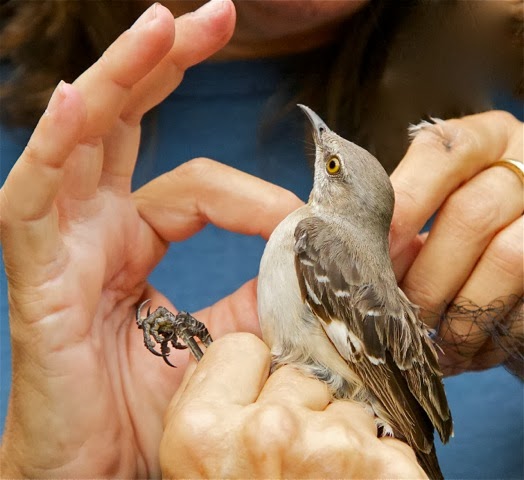
We captured two other Palm Warblers, a Gray Catbird, and a Northern Mockingbird.
Palm Warbler and its cute yellow pads of its feet
Photo by Bill Eaton
Northern Mockingbird
Photo by Bill Eaton
Sometimes three hands are better than two! Larger birds are harder to hold and still be able to remove the net. This bird's wing was very tangled so Nancy Price held it could be safely extracted.
Northern Mockingbird
Photo by Bill Eaton
The outer tail feathers fold underneath and you can see that this bird is missing its white outer tail feathers on its left side. The new feathers are "in sheath" growing in.
One of the recaptures was a White-eyed Vireo that we banded in February. Bill Eaton got some wonderful photos. One really shows how wingbars are formed from white edgings on individual wing covert feathers.
White-eyed Vireo
White-eyed Vireo - wingbar
Next banding will be December 10. Nets go up at 6:30 am.
Subscribe to:
Posts (Atom)